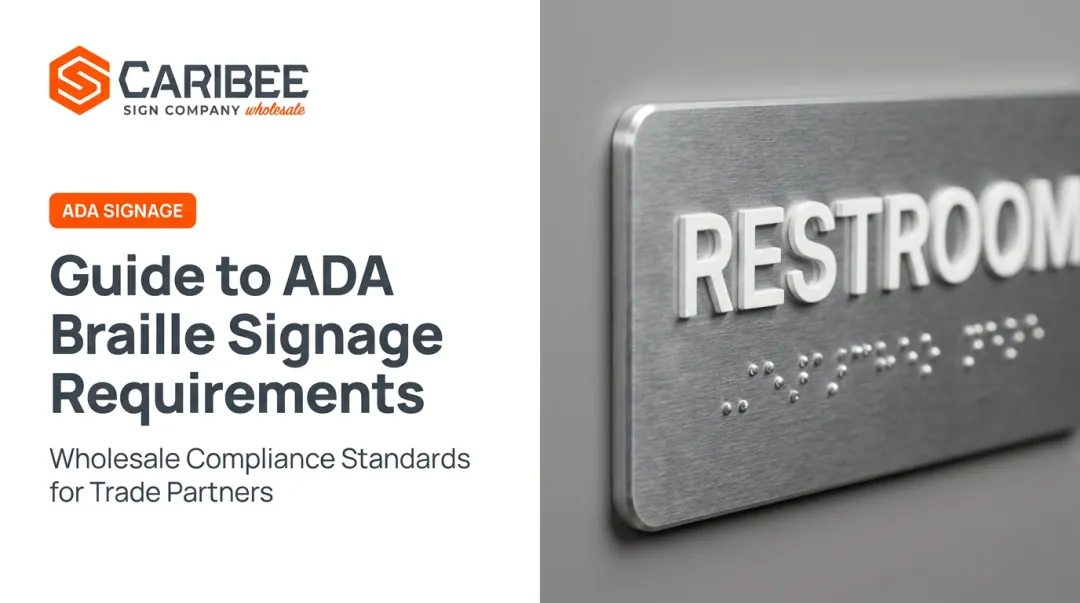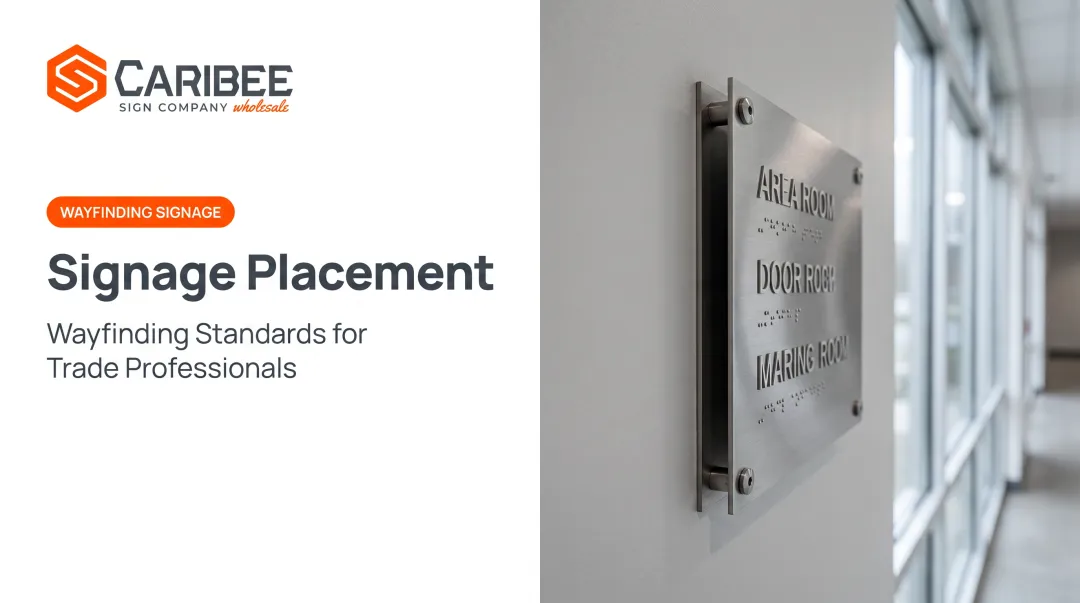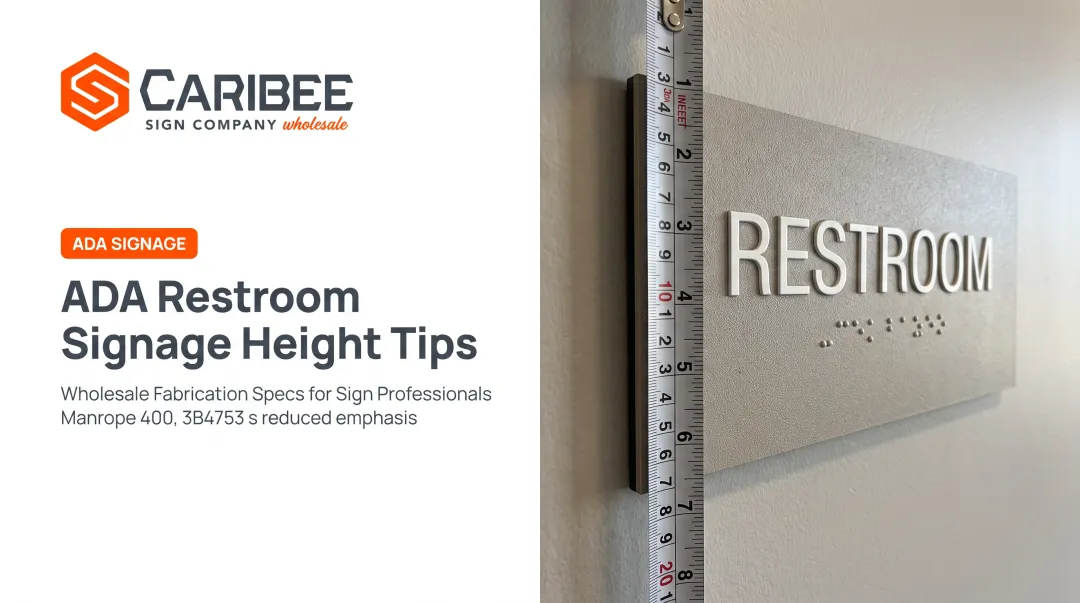

Mounting height, character size, Braille placement, and door location rules all interact. Miss one, and the whole sign gets pulled and remade. This guide breaks down the 2010 ADA Standards for Accessible Design (SAD) height rules, the specifications that go with them, and the mistakes that cause the most rework.
Key Takeaways
- Tactile signs mount 48–60 inches from the floor to the baseline of raised characters
- Signs belong on the latch side of doors, with 18"x18" clear floor space
- Character height, Grade 2 Braille, contrast, and font must meet specs—not height alone—for full compliance
- The 2010 ADA Standards remain the federal baseline in 2026. No new federal update has replaced them
- An experienced ADA signage manufacturer lowers failed-inspection risk on height and related specs
What ADA Signage Height Requirements Represent
ADA sign mounting height refers to the vertical placement of tactile characters and Braille, governed by the ADA Standards for Accessible Design (SAD) Section 703.4.1. This fixed constraint keeps tactile information within reach for wheelchair users and standing adults alike.
Here's where a lot of confusion starts: tactile sign height and general signage height are two different things.
- Tactile sign height — measured to the baseline of the raised character, this is the 48–60 inch rule
- General signage height — applies to overhead or directional signs, governed by separate clearance rules (more on that below)
Factors That Influence Correct Height Application
On a real job, these variables change how the height rule applies:
- Sign type — tactile room ID signs follow §703.4.1; visual-only directional signs don't
- Door configuration — single door, double door with one or two active leaves, or outward-swinging doors each change placement
- Wall space — if latch-side space is too tight, the nearest adjacent wall becomes the mounting location
- State/local overlays — California, for example, measures the 48-inch minimum to the bottom of the Braille cells, not the text baseline, per the 2022 California Access Compliance Advisory Reference Manual
That last point matters more than most installers realize. A sign built to federal spec can still fail a California inspection if it wasn't laid out against the state's Title 24 measurement point.
ADA Sign Mounting Height Range and Placement Rules
Height and placement are governed jointly by 2010 ADA Standards for Accessible Design (SAD) §703.4.1 and §703.4.2. Both must be correct together or the installation fails inspection.
Nominal Mounting Height
- Tactile characters must fall between 48 and 60 inches from the floor to the baseline of the lowest character
- Most installers standardize at 54 inches to center, creating a consistent line across signs of different sizes

Door and Wall Location Rules
- Signs go on the latch side of the door; use the nearest adjacent wall if latch-side space isn't available
- Provide 18" × 18" clear floor space, centered on the tactile characters, positioned outside the door's swing arc
Special Cases: Double Doors and Door-Mounted Signs
- One active leaf: mount centered on the inactive leaf
- Two active leaves: mount to the right of the right-hand door
- Door-mounted signs: allowed only when the door swings in the push direction, has an automatic closer, and has no hold-open device

General Hanging Requirements for Non-Room-ID Signs
Overhead and projecting signs follow a different set of rules, based on protruding-object safety requirements rather than the tactile-character baseline:
- Ceiling-hung signs: bottom edge at least 80 inches above the floor
- Wall-projecting signs: minimum 27 inches above the floor, projecting no more than 4 inches into the path
These aren't substitutes for the 48–60 inch tactile rule. They apply to circulation paths generally, and confusing the two is a common spec error.
Key Technical Specifications Beyond Height
Height alone doesn't make a sign compliant. Character design, Braille, and contrast all have to work together.
Character and Font Specifications
- Tactile character height: 5/8" to 2", measured from the baseline of an uppercase "I"
- Visual character height: Scales with viewing distance (larger rooms need larger letters)
- Characters must be uppercase, sans-serif, and not italic, script, or decorative
- Stroke width (visual): 10%–30% of character height per §703.5.7; no separate 15% cap applies to tactile letters, despite that figure circulating in some sign-shop references
Braille and Contrast Requirements
- Grade 2 (contracted) Braille sits directly below the corresponding tactile text, with a minimum 3/8" clearance from other tactile elements
- Finish must be non-glare, with either light characters on a dark background or dark characters on a light background
- No federally mandated numeric contrast percentage exists. The commonly cited 70% figure is industry guidance, not ADA law — don't quote it as a hard requirement to a client.

How ADA Signage Is Specified, Measured, and Validated
Compliance is both a design specification and a field-verification process.
Before installation, most experienced sign professionals:
- Reference the 2010 ADA Standards for Accessible Design (SAD) and architectural drawings to confirm required locations against code checklists
- Measure on site with a tape measure and torpedo level to confirm mounting height, floor clearance, and door-swing clearance before drilling
- Map ADA sign locations for multi-sign facilities, cross-checking each required location against blueprints room by room
For a hospital or campus with 200+ doors, that mapping step is what prevents a callback three weeks after installation.
Common Mistakes and Consequences of Non-Compliance
Most failed inspections come down to a short list of repeat offenders:
- Incorrect mounting height — outside 48–60 inches, or placed inside the door swing arc
- Missing tactile elements or Braille omitted entirely
- Low contrast or glossy finishes that fail legibility checks despite correct height
- Non-compliant fonts — script, italic, or decorative lettering on tactile signs
The financial risk is real. Under 28 CFR 36.504, DOJ Title III enforcement allows civil penalties up to $75,000 for a first violation and $150,000 for a subsequent violation.

These are maximum figures assessed by a court, not automatic per-sign fines, but they underscore why rework is expensive to ignore.
This is where the manufacturing partner matters as much as the installer. Caribee Sign produces ADA signage in-house using CNC routing and laser engraving, with Grade 2 Braille translated internally so sign companies don't have to source it separately.
Hugh Welch of Hugh-Carolina Sign Co. called Caribee his company's "go-to" for ADA signage needs, citing responsiveness and consistent, compliant quality. For sign companies juggling multiple jurisdictions and building types, that consistency reduces the odds of a sign coming back.
Conclusion
ADA sign height is a fixed compliance requirement. The 48–60 inch tactile rule, correct door-side placement, and 18"x18" clear floor space all have to line up together.
Height alone still won't pass inspection. It has to pair with:
- Correct character size
- Grade 2 Braille
- Non-glare contrast
- Compliant fonts
Partnering with a manufacturer that builds these specifications into production from the start, like Caribee Sign, helps sign companies deliver dependable, compliant results without the rework.
Frequently Asked Questions
What are the ADA signage requirements?
ADA requires tactile characters, Grade 2 Braille, high-contrast non-glare finishes, and compliant fonts. Mounting height and location must also follow the 2010 ADA Standards for Accessible Design.
What is the ADA-compliant mounting height for signs?
Tactile signs must be mounted between 48 and 60 inches from the floor to the character baseline. Most installers standardize at 54 inches as a common center point.
What is the minimum size for ADA signage?
Tactile characters must be at least 5/8" tall and no more than 2" tall. The ADA does not set an overall sign size, but it does require proportional clearances around text and Braille.
Where are tactile signs required?
Tactile signs are required at permanent rooms — restrooms, offices, stairwells, and floor-level identification. Temporary signage and directories are generally exempt.
What are the ADA requirements for digital signage?
Static signage remains the compliance foundation under current federal standards. Some jurisdictions now expect digital displays to offer alternate accessible formats, but no federal tactile rule covers digital screens directly.
What are the new ADA guidelines for 2026?
The 2010 ADA Standards remain the active federal baseline, with no new federal update to physical signage rules. Some states, like California, have added stricter local measurement requirements.