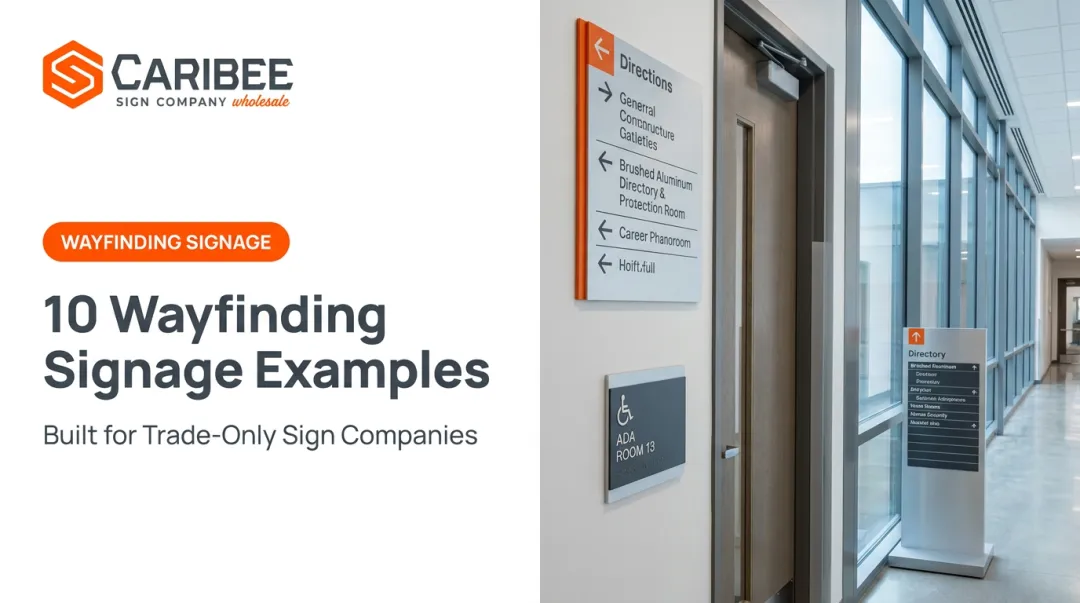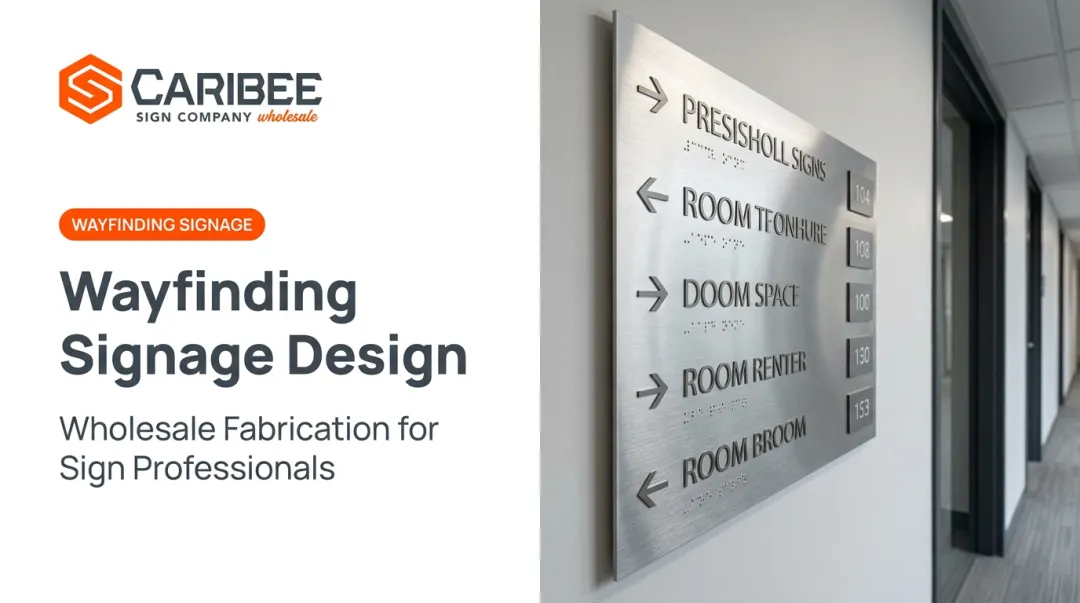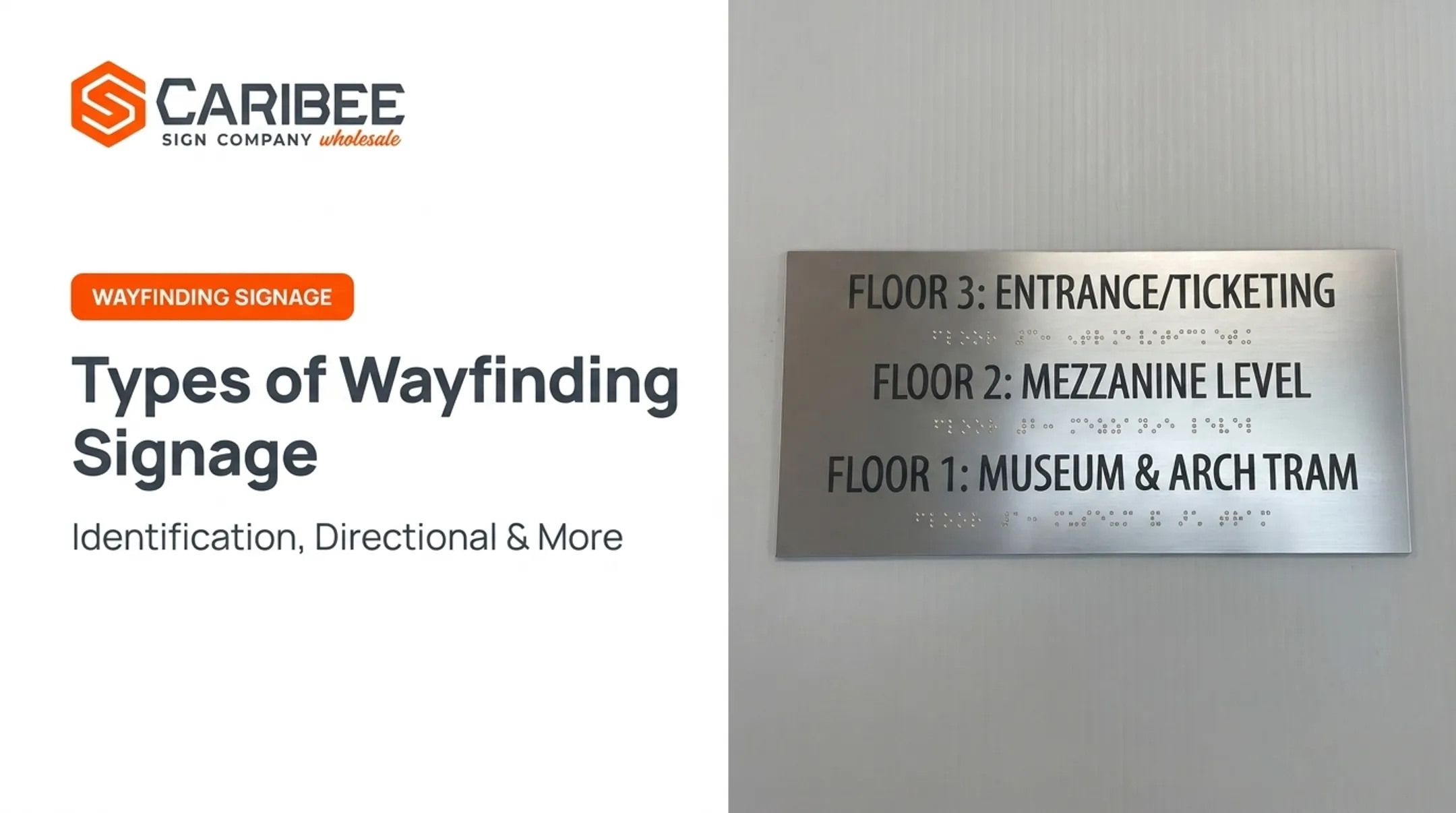

Wayfinding signage is the system of signs and visual cues that help people orient themselves, choose a route, and confirm they've reached the right destination. It matters across offices, hospitals, schools, and retail spaces alike, where safety, ADA compliance, and a smooth visitor experience all depend on getting it right.
This article breaks down what wayfinding signage actually is, the four main types you'll need, and how to choose the right mix for your facility.
TL;DR
- Wayfinding signage guides people using identification, directional, informational, and regulatory signs
- Clear systems cut confusion, improve safety, support accessibility, and reinforce brand identity
- Each sign type answers a different navigational question—where you are, where to go, what to know, or what rules apply
- Match the mix to facility size, audience, and ADA/code compliance needs
What Is Wayfinding Signage?
Wayfinding signage isn't one sign. It's a coordinated system of visual cues that tells people where they are, where they can go, and how to get there.
You'll find it in:
- Corporate offices and business parks
- Hospitals and medical campuses
- Schools and universities
- Retail centers and shopping malls
- Multi-family residential communities
The best wayfinding systems share a common backbone: consistent design, logical placement, and a clear hierarchy of information. A directory that uses different terminology than the hallway signs it references creates confusion instead of solving it. Effective wayfinding treats every sign as part of one connected journey, not a standalone graphic.
Why Is Wayfinding Signage Important?
Poor wayfinding doesn't just annoy people. It costs real time and creates real safety risk.
A 2025 survey of US hospital staff found that navigation confusion creates a serious operational drain. Staff reported spending an average of 31.82 minutes per week helping visitors find their way.
Researchers extrapolated that figure to roughly 98 million nurse hours lost annually across US hospitals. That's the equivalent of over 51,000 full-time positions.

The same survey found:
- 57% of respondents said wayfinding difficulties were frustrating
- 44% reported experiencing incivility from frustrated visitors
Beyond staff time, unclear wayfinding creates safety gaps. Emergency egress routes and accessible paths need to be immediately identifiable, not something a visitor has to guess at during a fire drill or a mobility challenge.
Without effective wayfinding, facilities typically see:
- Lost visitors and missed appointments
- Constant front-desk interruptions for directions
- Poor first impressions that affect brand perception
- Increased risk of ADA and building code non-compliance
Types of Wayfinding Signage
Wayfinding works because it's built from distinct sign types, each answering a different question along someone's journey: Where am I? Which way do I go? What do I need to know? What am I required to follow?

Identification Signage
Identification signs answer one question: "Have I arrived?" Think room plaques, department markers, and building entrance signs.
- Best suited for: entrances, offices, room doors, building fronts
- Key strength: confirms location and builds visitor confidence
- Limitation: doesn't help with route planning on its own; needs pairing with directional signs to be useful
Directional Signage
Directional signs use arrows, directories, and floor markers to guide movement from one point to another.
- Best suited for: hallways, junctions, large campuses, multi-story buildings
- Key strength: manages decision points and cuts down on backtracking
- Limitation: symbols and colors must stay consistent facility-wide, or they create more confusion than clarity
Informational Signage
These signs provide context: hours of operation, amenities, maps, or facility rules.
- Best suited for: lobbies, kiosks, waiting areas, museums
- Key strength: answers common questions upfront, reducing front-desk traffic
- Limitation: cramming too much onto one sign overwhelms rather than helps
Regulatory Signage (Including ADA-Compliant Signage)
Regulatory signs communicate mandatory rules, safety information, and accessibility requirements. This category includes ADA signage with raised lettering and Braille.
- Best suited for: restrooms, accessible entrances, exits, restricted areas
- Key strength: legal compliance and safety assurance for every user
- Limitation: design flexibility is limited by code requirements
Under the 2010 ADA Standards, permanent room signs must include:
- Raised uppercase sans-serif characters with contracted Grade 2 Braille
- Mounting height between 48 and 60 inches above the finished floor
- Non-glare finish with strong contrast between text and background

Because those rules leave little room for improvisation, many sign companies source ADA work through a wholesale partner already set up for compliance. Caribee Sign builds ADA-compliant products with raised tactile characters, Grade 2 Braille, and high-contrast visuals from the start.
Braille translation support is included, so trade partners do not have to assemble compliance expertise on their own.
How to Choose the Right Mix of Wayfinding Signage
There's no single formula. The right combination depends on a handful of practical factors.
- Facility size and complexity: A single-floor office needs far less than a multi-building hospital campus with dozens of decision points.
- Visitor type: Employees who navigate the space daily need less guidance than first-time visitors, patients, or guests.
- Budget and durability: Indoor acrylic costs less in controlled spaces; exterior work needs weather-resistant aluminum or composites that last longer.
- ADA and local code compliance: Build this in from day one. The 2024 IBC requires directional signage to the nearest accessible element at inaccessible entrances, restrooms, elevators, and drinking fountains. Retrofitting later costs more.
- A dependable production partner: As facilities grow or renovate, sign companies need a manufacturer who can turn around consistent, ADA-ready signage without repeated back-and-forth.

Caribee Sign's in-house CNC routing and laser engraving support this kind of ongoing relationship. Quotes are typically answered within one business day. Custom sizing, materials, and finishes are handled project by project, which matters when a healthcare system or school district is adding buildings over time.
Common Mistakes to Avoid
A few recurring errors undermine otherwise well-designed wayfinding systems:
- Inconsistent naming — If the directory calls it "West Wing" but the hallway sign says "Building B," visitors get stuck
- Information overload — Cramming every detail onto one sign defeats the purpose; prioritize what matters most
- Treating ADA as an afterthought — Compliance should shape the sign schedule from the start, not get bolted on during final inspection
- Skipping the first-timer test — Walk the route as a visitor who's never been there before; assumptions about "obvious" navigation rarely hold up
Frequently Asked Questions
Can you give me an example of wayfinding signage?
Common examples include a lobby directory listing departments, hallway directional arrows pointing toward exits, room identification plaques on doors, and ADA-compliant restroom signs with raised text and Braille.
How much is wayfinding signage?
Cost varies significantly by material, size, sign type, and customization such as Braille or tactile elements. Get a project-specific quote from a supplier for accurate pricing.
What are the four types of wayfinding signage?
The four types are identification (confirms arrival), directional (guides movement), informational (provides context), and regulatory or ADA signage (communicates rules and accessibility requirements).
Is wayfinding signage required by law?
Yes, in many cases. The ADA requires tactile and Braille signage at permanent rooms, and the 2024 IBC mandates exit signs and accessible-route signage under specific conditions.
What materials are best for wayfinding signage?
Interior signage commonly uses acrylic, stainless steel, brushed metal, or wood, while exterior signage typically needs weather-resistant aluminum or composite materials. The right choice depends on exposure and durability needs.
Who needs wayfinding signage?
Any multi-room or multi-building facility benefits, including offices, hospitals, schools, retail centers, hotels, and multi-family residential communities where visitors need to navigate independently.