
Introduction
Escalators carry roughly 105 billion passengers a year across the United States, according to NEII's 2020 industry fact sheet. Most riders never glance at the caution sign posted at the landing.
That's the problem. Escalators are mechanically complex, high-traffic equipment, and caution signage is often the last line of defense before an injury.
For building owners, property managers, and the sign companies that serve them, missing or non-compliant signage isn't just a maintenance oversight. It's a liability exposure. When an accident happens near an escalator without proper warnings, that gap can become evidence in a premises liability claim.
This guide breaks down the sign types the codes require, how ASME A17.1 and ADA rules apply, where signs need to be placed, and how sign companies can source compliant escalator signage without guesswork.
Key Takeaways
- Escalator signage is mandated by codes like ASME A17.1, not left to owner discretion
- Specify four categories: passenger warnings, mechanical hazard decals, emergency signs, and ID plates
- Correct placement, contrast, and durable materials keep signage compliant and readable over time
- Partnering with an experienced ADA signage manufacturer reduces compliance risk for recurring projects
Why Escalator Safety Signage Is Essential
Escalators combine moving steps, exposed handrails, and pinch points at the comb plate, all operating continuously in spaces with heavy foot traffic. Clear signage is the cheapest and most direct way to reduce preventable injuries before they happen.
The Real Cost of Escalator Accidents
According to the Consumer Product Safety Commission, there were approximately 11,000 escalator-related injuries in 2007 alone, most involving falls. Roughly 10% of those injuries involved hands, feet, or shoes getting trapped in the mechanism, with feet the most common entrapment point.
Missing or damaged signage doesn't just increase injury risk. It also shapes liability outcomes. In Reynolds v. Amtrak, a 2024 federal case, the plaintiff alleged negligence tied specifically to a failure to barricade the escalator or warn of its hazards. That kind of allegation is common in premises litigation once an incident occurs near unmarked or poorly maintained equipment.

Regulatory Mandates Driving Sign Requirements
Those liability risks are why regulators treat escalator warnings as mandatory, not optional. ASME A17.1 (harmonized with CSA B44 in Canada) requires a caution sign at both escalator landings. Nearly every U.S. jurisdiction adopts that baseline in some form.
Businesses open to the public layer on a second obligation: ADA accessibility standards for any adjacent wayfinding or directional signage. The two frameworks work together but aren't interchangeable—and treating them as one requirement is a common compliance miss.
Essential Types of Escalator Safety Signs
Escalator signage isn't one universal placard. It splits into distinct functional categories, each tied to a different part of the code.
| Sign Type | Primary Purpose | Typical Requirement Source |
|---|---|---|
| Passenger caution sign | Warns riders before boarding | ASME A17.1 (both landings) |
| Pinch-point/hazard decal | Flags entrapment risk at comb plate | Supplemental to A17.1 |
| Emergency stop labeling | Identifies shutoff controls | State/local amendments |
| Identification/inspection plates | Documents equipment and certification | Local jurisdiction (e.g., NYC, D.C.) |
Passenger Instruction & Warning Signs
The core A17.1 caution sign carries five specific messages: "Caution," "Passengers Only," "Hold Handrail," "Attend Children," and "Avoid Sides." CPSC guidance adds further rider instructions, like facing forward and avoiding strollers, walkers, or carts on the escalator.
- Pictogram-based versions use a standardized image of a person on moving stairs for universal comprehension
- Text versions let facilities add specific instructions beyond the baseline five messages
- Both formats typically appear together at each landing
Pinch Point & Mechanical Hazard Warnings
Entrapment accounts for roughly one in ten reported injuries, so decals near the comb plate and skirt panels are essential. These typically warn against loose clothing, dangling shoelaces, and bare feet, the most common causes of mechanical entrapment.
Emergency Stop & Operational Signage
Local codes get specific here.
- California: protected red stop controls near both landings
- New York City: stop buttons on the right side facing the escalator at each end
"Out of service" signage and barricades are also standard practice during maintenance windows, even though no single national wording is mandated.
Capacity, Identification & Inspection Plates
Unlike elevators, escalators don't have a universal passenger-facing capacity plate requirement under national code. Jurisdictions still require unique equipment IDs (New York City mandates characters at least 0.25 inches high) and, in places like Washington, D.C., a current inspection certificate conspicuously displayed on the unit.
Navigating Escalator Signage Regulations & ADA Compliance
Escalator signage compliance is a layered obligation: national code, local amendments, and accessibility law.
ASME A17.1 Safety Code Requirements
The controlling document, ASME A17.1-2019/CSA B44:19, addresses the caution sign in Section 6.1.6.9.1. It requires a pictographic sign at both landings, visible to boarding passengers, carrying the five verified messages noted above. Manufacturers follow this wording closely because deviation can create a compliance gap during inspection.
ADA Compliance Considerations
Here's a detail that trips people up: proximity to an escalator doesn't automatically make a sign ADA-tactile. ADA scoping depends on function, not location, per the U.S. Access Board.
- Directional or informational signs near an escalator follow visual character rules only
- Signs identifying a permanent space (like a floor directory) require tactile characters plus Grade 2 Braille
- Tactile characters must be mounted 48 to 60 inches above the floor; visual characters start at 40 inches

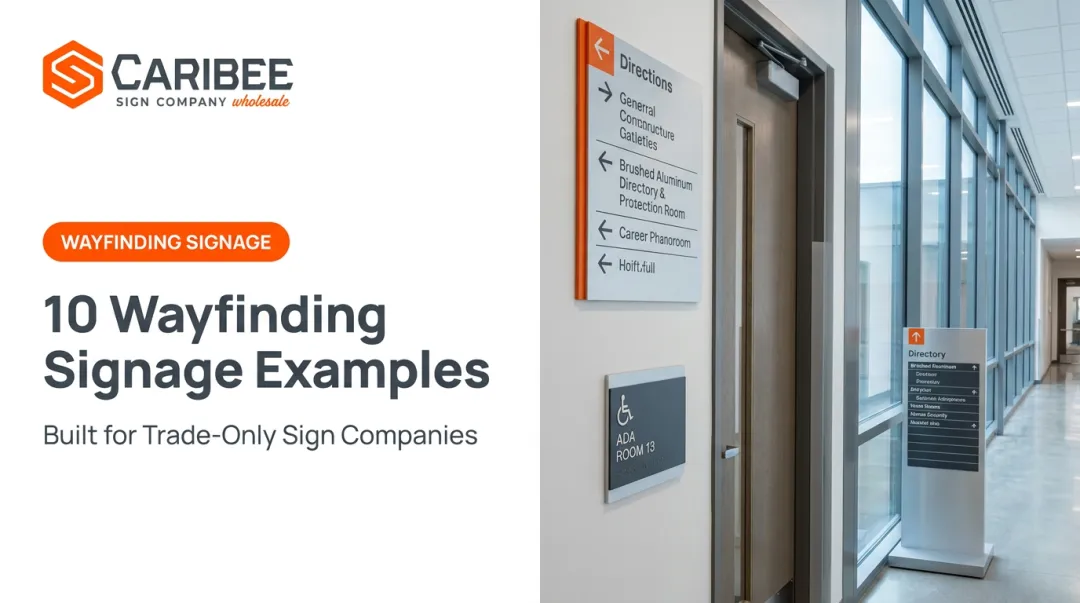
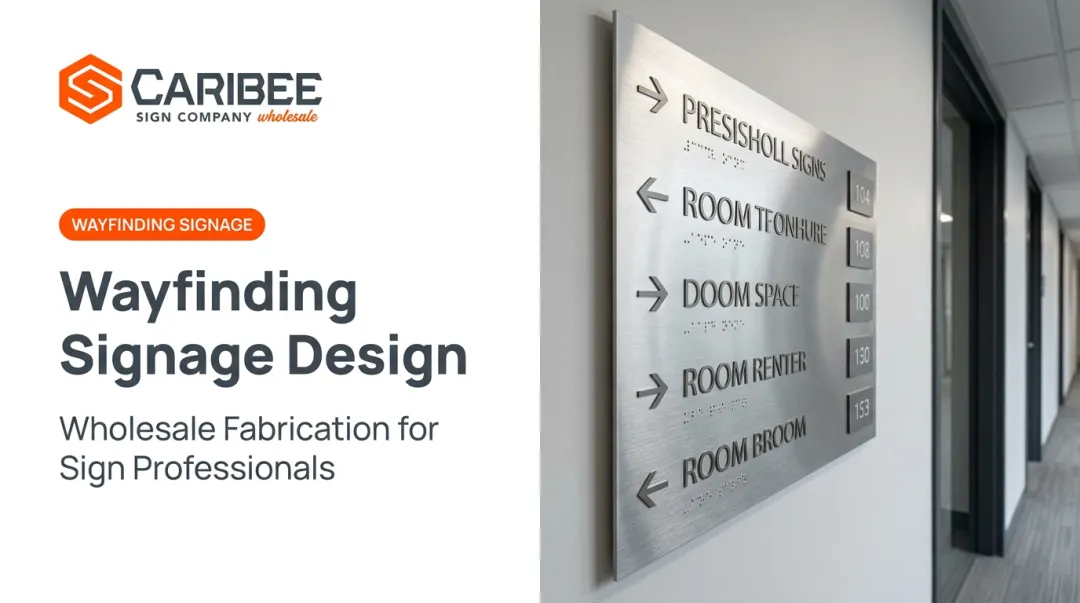
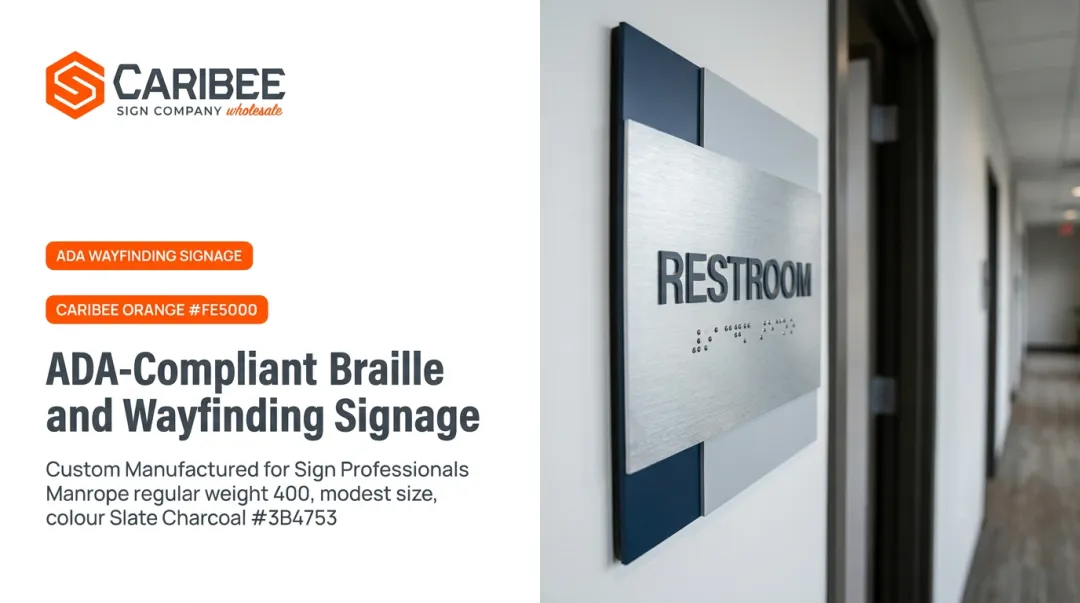
When adjacent wayfinding does fall under ADA rules, Caribee Sign produces the tactile, Braille, and high-contrast signs as a trade-only wholesale manufacturer in St. Louis. Braille translation is handled in-house, so partner sign companies don't need a separate source.
Local & State Code Variations
National code sets the floor, not the ceiling. Local jurisdictions often add their own requirements:
- California: illuminated safe-use signs at landings
- New York City: stop-button placement and equipment IDs
- Washington, D.C.: visible inspection certificates
Before specifying signage, check the local building or elevator/escalator code. These variations are enforced independently of ASME A17.1.
Design, Material & Placement Best Practices
Signage that's technically compliant but illegible or worn out doesn't protect anyone. Material and placement choices determine whether a sign actually works.
Materials for high-traffic zones:
- Aluminum or engraved metal for long-term durability against abrasion
- UV-stable vinyl for signage exposed to sunlight near entrances
- Laser-engraved plastic for crisp, permanent lettering that won't peel
Legibility standards:
- High color contrast (dark-on-light or light-on-dark) so signs read clearly from a distance
- Fonts large enough to read from the approach, not only up close
- Non-glare finishes to prevent reflection under overhead lighting
Placement zones that matter most:
- Top and bottom landings, positioned for visibility before boarding
- Along the balustrade at a height where approaching riders will naturally see them
- Near the comb plate for hazard-specific warnings
Important restriction: A17.1 doesn't allow supplemental signage placed inside the escalator's entrance or exit safety zones. Anything beyond the mandatory caution sign needs to sit outside that zone.
Partnering with the Right Escalator Signage Manufacturer
Sourcing escalator and elevator-adjacent signage piecemeal, one vendor for ADA elements, another for hazard decals, creates inconsistency and rework. A single manufacturing partner solves that.
What to look for in a partner:
- ADA compliance expertise: Braille translation and tactile fabrication handled in-house, not as an afterthought
- Material and production versatility: CNC routing and laser engraving for durable metal, acrylic, and vinyl
- Consistent turnaround: Predictable lead times for multi-site rollouts
- No forced minimum order quantities: Flexibility for one-off and recurring projects
Caribee Sign fits this model for the ADA-compliant side of escalator-adjacent signage. As a wholesale-only manufacturer serving sign companies nationwide, it produces tactile, Braille, and high-contrast wayfinding and identification signage entirely in-house, with standard lead times of 2 to 3 weeks after artwork approval and no stated minimum order requirement.

Partners like Hugh-Carolina Sign Co. use Caribee as their go-to source for ongoing ADA signage—useful when you are juggling multi-site programs across different jurisdictions.
For escalator-specific hazard decals or mechanical warnings outside the ADA scope, include detailed project specs in a quote request. Caribee's team typically responds within one business day and can advise on whether a custom fabrication run fits the project.
For sign companies running recurring orders across multiple properties, one wholesale partner keeps ADA specs, lead times, and quality aligned—so you spend less time fixing mismatches and more time installing.
Frequently Asked Questions
What is the sign for an escalator?
Escalator signs typically use a standardized pictogram of a person on moving stairs, paired with text such as "Hold Handrail" or "Attend Children." ASME A17.1 requires this caution signage at both landings.
What are the two main types of escalator-related signage?
Escalator-related signage falls into two types: regulatory caution signs required by code (such as landing warnings) and informational or wayfinding signs used for directions and identification nearby.
Are escalator safety signs legally required?
Yes. Codes like ASME A17.1 mandate specific caution signage at escalator landings, and missing or non-compliant signs can factor into liability claims against property owners.
Where should escalator safety signs be placed for compliance?
Signs belong at both the top and bottom landings and along the balustrade, positioned at a height clearly visible to riders as they approach.
Do escalator signs need to meet ADA requirements?
The escalator caution sign itself follows ASME code, not ADA rules. However, nearby wayfinding or accessibility signage often does need ADA-compliant tactile text, Braille, and contrast.
How often should escalator signage be inspected or replaced?
Check signage during routine escalator maintenance. Replace anything faded, cracked, or peeling right away—there is no fixed national replacement schedule beyond keeping signs secure and legible.