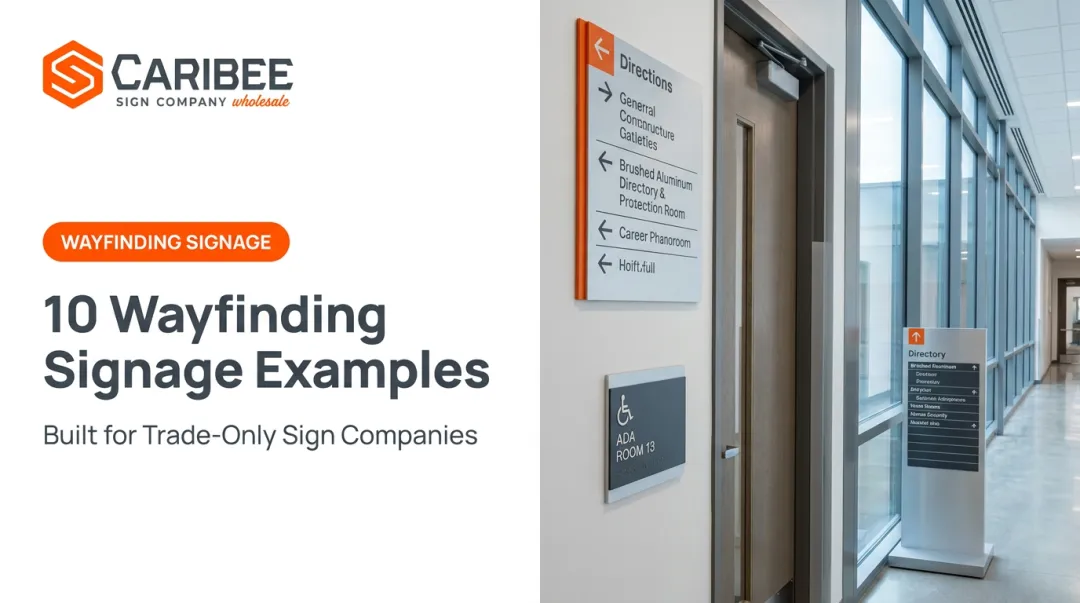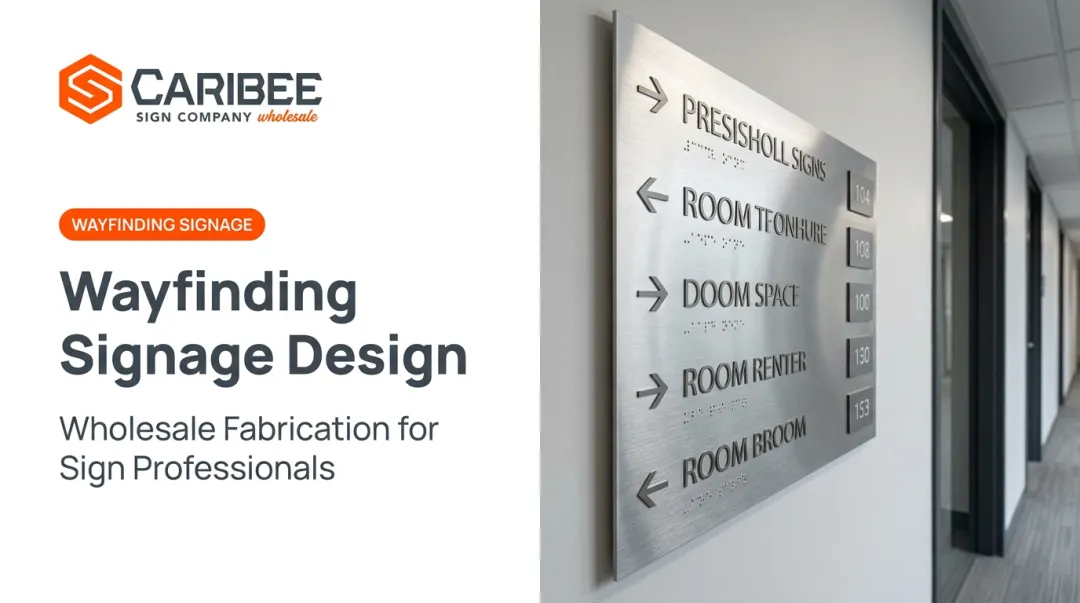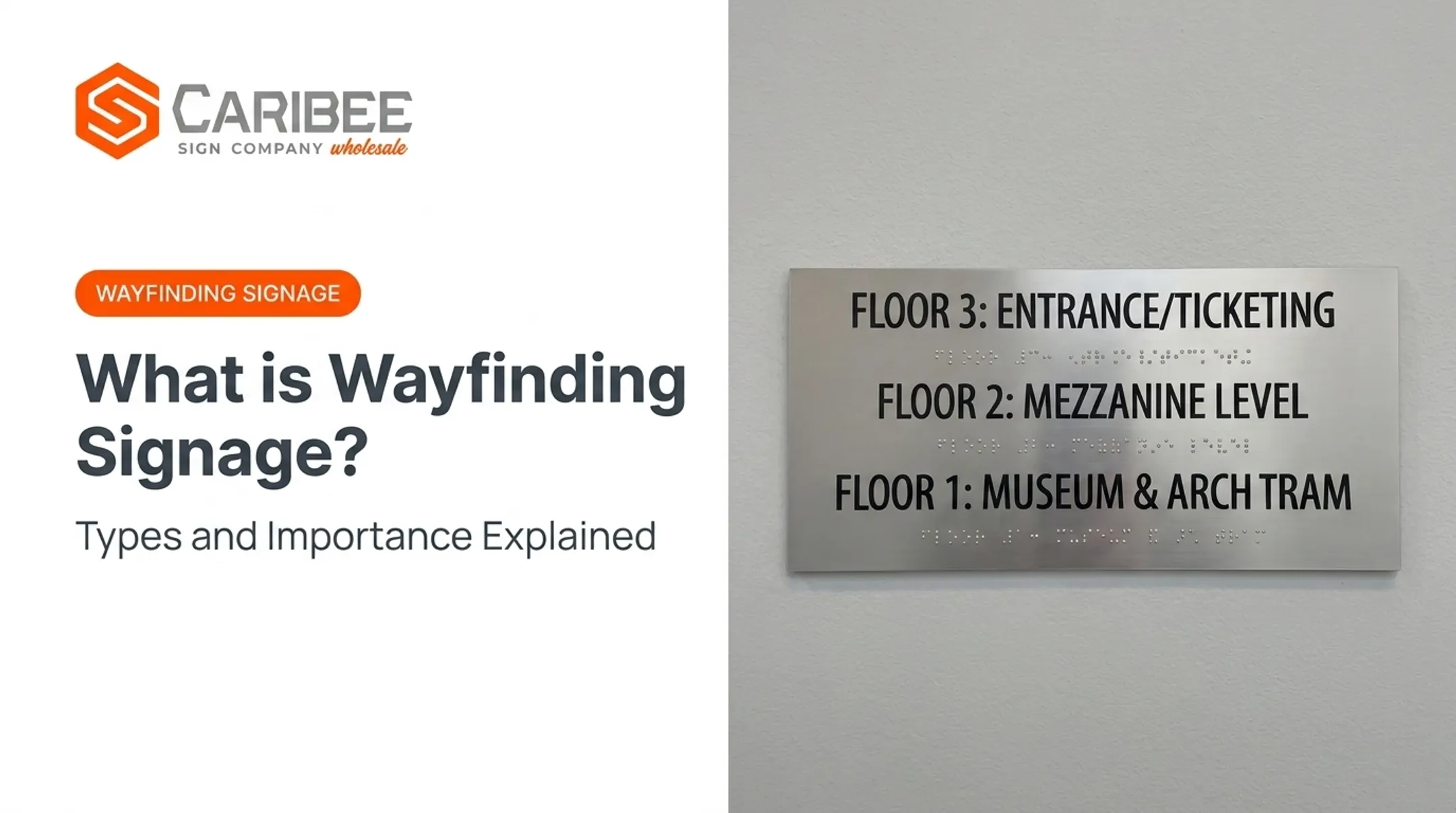

That scenario plays out daily in hospitals, campuses, and office complexes across the country. Wayfinding signage exists to prevent it.
Poor navigation isn't just an inconvenience. In a 2025 survey of U.S. hospital staff, staff reported spending an average of 31.82 minutes per week helping lost visitors find their way, with 57% describing the resulting frustration and 44% reporting incivility from confused visitors.
This article breaks down the four core types of wayfinding signage, how each functions differently, and how to combine them into a system that actually works.
TL;DR
- Wayfinding signage is a system of signs, not a single sign type
- Four core functions: identification, directional, informational, and regulatory
- Each type answers a different visitor question: Where am I? Which way? What should I know? What's required?
- The right mix depends on facility size, visitor type, and ADA compliance requirements
What Is Wayfinding Signage and Why Does It Matter?
Wayfinding signage is the network of signs, symbols, and visual cues that helps people orient themselves and move confidently from one point to another. Airports, hospitals, universities, offices, and multi-tenant buildings all rely on it to keep foot traffic moving without constant staff intervention.
When it works, wayfinding signage delivers:
- Fewer interruptions to staff for basic directions
- Reduced visitor frustration and stress
- Faster, safer movement during emergencies
- A stronger first impression for guests and clients
When it doesn't work, the costs compound. A 2025 hospital survey found that staff assist lost visitors roughly four times per week, at about seven minutes per episode. Cafeterias, restrooms, exits, and main lobbies were the most common destinations people struggled to find.
Missing or inconsistent signage also creates legal exposure. Room identification and exit-route signs fall under ADA-mandated tactile and visual requirements, and gaps in coverage can mean non-compliance, not just confusion.
Types of Wayfinding Signage
A complete wayfinding system rarely relies on one sign type. Instead, it layers several types together, each doing a different job at a different point in the visitor's journey.
Identification Signage
Identification signage confirms a location. It doesn't guide movement — it tells someone they've arrived. Think room plaques, department markers, building names, and "You Are Here" indicators.
Best suited for: entryways, room doors, department entrances, campus buildings, exterior facades
Strengths:
- Reassures visitors they've reached the correct destination
- Reduces uncertainty at the end of a route
Limitation: Identification signage can't help someone who hasn't found the right path yet. It must be paired with directional signage to be useful.

Directional Signage
Directional signage uses arrows, text, and symbols placed at decision points to guide movement. This action-oriented layer shows up at hallway junctions, elevator lobbies, and intersections rather than at the destination itself.
Best suited for: large facilities with multiple entries, complex layouts, or several possible routes to the same destination
Strengths:
- Keeps foot traffic flowing without staff assistance
- Reduces bottlenecks at busy decision points
Limitation: Poorly placed or inconsistent directional signage can create more confusion than having no signage at all. Sequence and placement matter as much as wording.
Informational Signage
Informational signage supplements the journey with useful context rather than pointing toward a destination. Hours of operation, Wi-Fi availability, parking rules, and static maps all fall into this category.
Best suited for: lobbies, waiting areas, parking lots, reception zones
Strengths:
- Reduces the need for staff assistance
- Builds visitor confidence early in the journey
Limitation: Cramming too much information onto one sign overwhelms visitors. Prioritize what matters most at that specific location.
Regulatory Signage
Regulatory signage communicates rules, restrictions, and legally required information — PPE requirements, restricted-access zones, accessible-route markers, and exit identification.
Best suited for: emergency exits, accessible routes, restricted areas, and any zone with safety or legal implications
Strengths:
- Reduces liability exposure
- Keeps facilities safe and accessible for all visitors, including those with disabilities
Limitation: This category carries the highest compliance risk. Permanent room identification and specified exit doors require raised tactile characters and Grade 2 Braille. Those characters must sit within specific baseline height ranges, on the latch side of the door, with clear floor space beyond the swing.

Getting these details wrong creates real exposure for sign companies and their facility clients. That is why many sign companies partner with a wholesale ADA manufacturer like Caribee Sign. Teams that build tactile and Braille signage daily are less likely to miss a mounting-height or contrast requirement buried in the standard.
How to Choose the Right Types of Wayfinding Signage
There's no universal formula. The right combination depends on your facility's layout, who's moving through it, and what compliance obligations apply — not on copying whatever a comparable building down the street installed.
Factors to Consider
- Facility size and complexity — more floors, entrances, and decision points mean more directional signage needed
- Visitor type — first-time visitors need more identification and directional support than daily employees
- Compliance requirements — ADA-mandated signage for accessible routes and room identification isn't optional
- Budget and maintenance — material durability and how often content will change affects long-term cost
What to Check Before Finalizing Your System
Before locking in a sign schedule, run through these checks:
- Check functional balance. Don't over-invest in directional signs while shorting identification or regulatory needs. All four functions should work as one system.
- Verify ADA details. Confirm tactile characters, Grade 2 Braille, contrast ratios, and mounting height before inspection day—not after a failed review.
- Audit messaging conflicts. Make sure identification, directional, and informational signs don't contradict each other or crowd the same decision point.
- Match materials to the environment. Spec weather-resistant aluminum or composites for exterior wayfinding instead of interior-grade substrates.

After the schedule clears these checks, production consistency matters as much as the plan. For sign companies running multi-site work, an ADA-compliant wholesale partner like Caribee Sign keeps quality and turnaround steady on a single wing or a full campus. Caribee builds room identification, directional, informational, and regulatory signage in-house at its St. Louis facility, with quotes typically back within one business day.
Conclusion
Wayfinding signage works as a system of four distinct functions — identification, directional, informational, and regulatory — layered together so people can navigate a space without second-guessing every turn.
Get the mix right, and visitors move through your facility without needing to ask staff for help. Get it wrong, or skip the ADA details, and you end up with frustrated visitors, safety risks, and compliance gaps that cost more to fix after the fact.
Frequently Asked Questions
What are wayfinding systems?
A wayfinding system is a coordinated network of signs, symbols, and visual cues that help people navigate a space. It works at every decision point along the journey, rather than as a single standalone sign.
What are the different types of signage?
The four core types are identification, directional, informational, and regulatory. Some sources also reference confirmational or symbol-based signage as a variation on these core functions.
Can you give me an example of wayfinding signage?
A "You Are Here" map at a building entrance, an elevator directory listing floor tenants, and an ADA-compliant room identification sign with raised characters and Braille are all common examples.
Are wayfinding signs required to be ADA compliant?
Many are. Permanent room identification signs and specified exit doors must meet ADA requirements for tactile characters, Grade 2 Braille, and mounting height. Purely directional or informational signs follow different visual-character rules.
How many types of wayfinding signs should a facility use?
Most effective systems combine all four types, since each answers a different navigational question. Relying on just one type, usually directional, leaves gaps in orientation, compliance, or context.
Who is responsible for maintaining wayfinding signage compliance?
Facility owners and sign companies share that responsibility. Working with an experienced ADA signage manufacturer reduces the risk of non-compliance across large or multi-site projects.