
UV printing technology has changed how these signs get made. Instead of drilling raster beads or thermoforming plastic by hand, UV-LED flatbed printers now build tactile text and braille dots digitally, layer by layer.
This guide covers the ADA braille standards you need to hit, how printers like the Mutoh XpertJet series produce compliant signage, and how to find a production partner who won't leave you guessing on compliance.
Key Takeaways
- ADA braille signs must hit exact DOJ 2010 Standards for dot height, spacing, and tactile lettering
- UV-LED flatbeds print tactile text, braille dots, and full-color graphics in one run
- Small measurement errors can make a sign non-compliant—precision tools are essential
- An ADA specialist like Caribee Sign helps sign companies cut compliance risk and delays
Understanding ADA Braille Sign Requirements
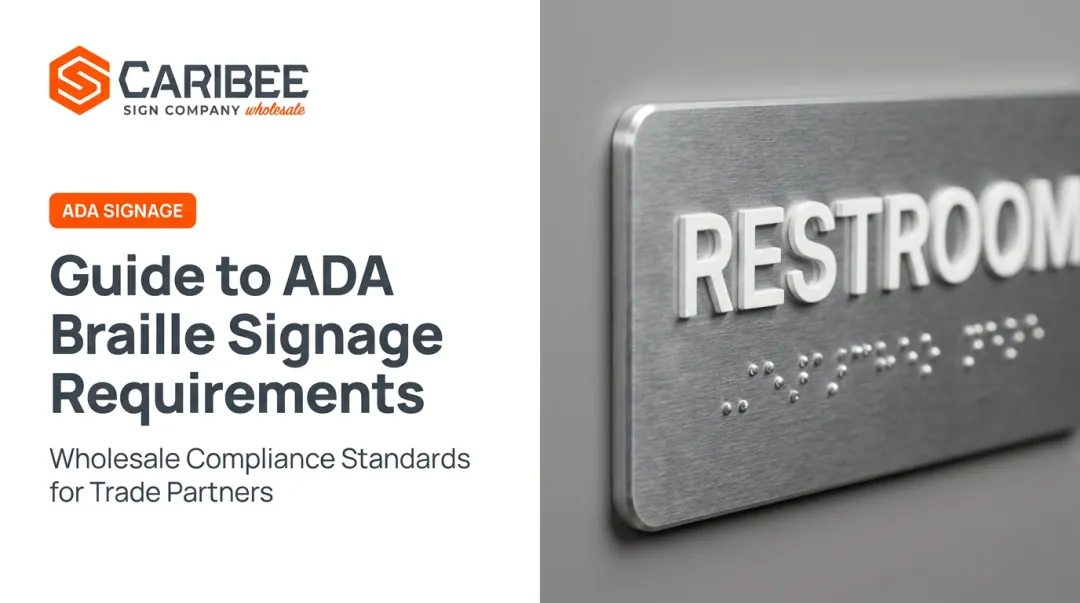
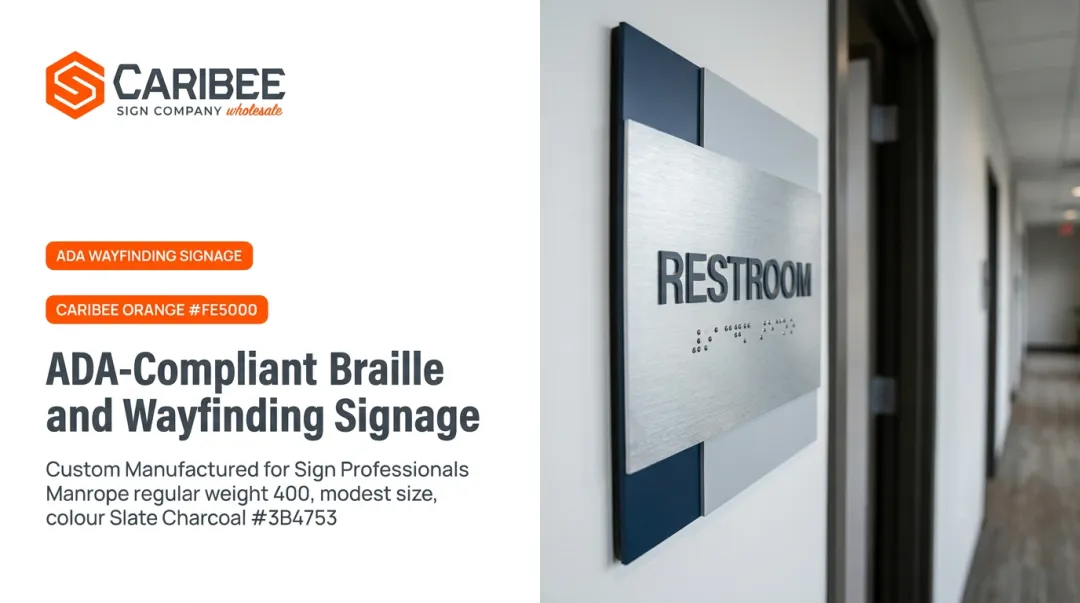
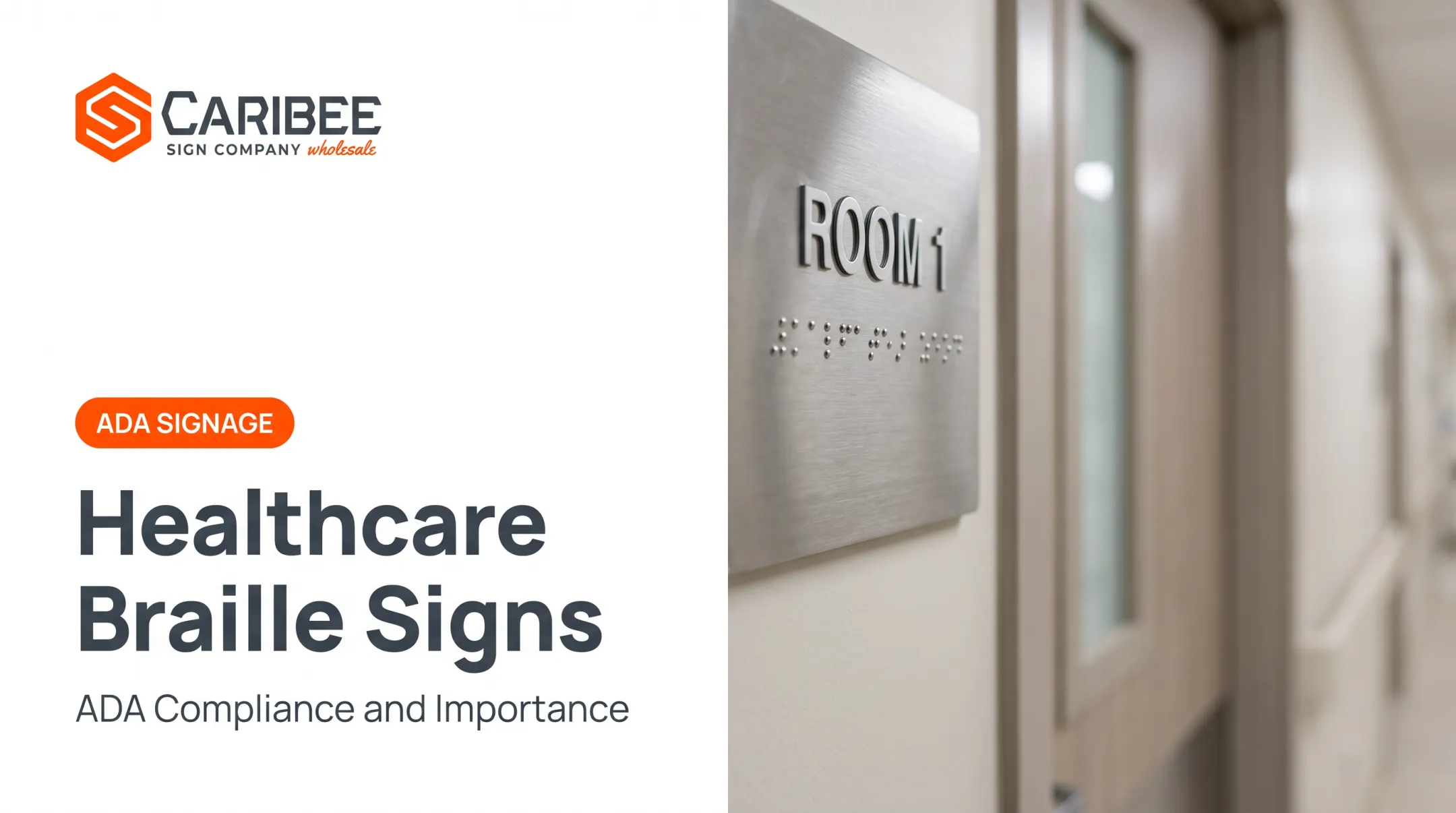
Not every sign in a building needs braille. Permanent room identifiers—restrooms, stairwells, and exam rooms—legally require tactile characters and Grade 2 braille. Wayfinding and directional signs generally don't, though they still need contrast and non-glare finishes.
The DOJ's 2010 ADA Standards spell out exact tolerances under Section 703:
- Raised characters: minimum 1/32 in projection, sans serif, uppercase, 5/8 in to 2 in in height
- Braille dot diameter: 0.059–0.063 in
- Same-cell dot spacing: 0.090–0.100 in
- Dot height: 0.025–0.037 in
- Mounting height: 48 in minimum to 60 in maximum above the finish floor
These numbers aren't suggestions. A dot spacing off by a hundredth of an inch fails the standard. That's why measuring with calipers and dedicated braille gauges before any sign ships is mandatory, not optional.

Common Compliance Mistakes to Avoid
Sign fabricators run into the same problems repeatedly:
- Using uncontracted braille instead of required Grade 2 translation
- Printing or engraving dots that aren't properly domed
- Placing braille too close to borders or other tactile elements (needs 3/8 in minimum clearance)
- Specifying tactile characters below the 1/32 in minimum projection
- Mounting signs at the wrong height or on the wrong door side
How UV Printers Create Custom Braille Signs
UV-LED flatbed printers build braille and tactile lettering by depositing layered clear varnish or raised white ink directly onto the substrate. No molds, no drilling, no separate raster beads glued in place afterward.
This is a real departure from older methods. Thermoforming and photopolymer processes involve multiple physical steps, and drilled raster beading can run over 30 steps per sign, according to a comparison from Direct Color Systems. UV printing collapses most of that into a single digital pass.
Single-Pass Production
Modern flatbeds print full-color graphics, tactile lettering, and braille dots in one run. There's no need to print the artwork, then separately apply braille elements in a second production stage. That single-pass capability is what makes fast turnaround possible on multi-sign orders.
The same process works on acrylic, metal, and wood, so shops can produce branded, ADA-compliant signs without switching methods for each material.

RIP Software and Quality Checks
RIP software manages file setup, controlling how varnish or ink layers get sequenced to build consistent dot height across an entire order. Before signs leave the shop, they should go through:
- Adhesion testing (cross-hatch or tape tests) to confirm raised elements won't peel
- Dot-height verification with calipers or braille gauges against Section 703 tolerances
- Spacing checks to confirm dot and cell placement meets ADA braille standards
Why Custom UV-Printed Braille Signage Makes Business Sense
Cost is where digital production separates itself from pre-made signage. Mutoh documented a regional medical center that found more than 1,500 noncompliant restroom and room signs.
The cost gap was stark:
- Pre-made acrylic replacements: above $100 per sign ($150,000+ total)
- In-house UV production: roughly $7 per sign
- Reported savings: north of $200,000
Figures come from Mutoh's published case example. A Digital Output Magazine write-up corroborates a hospital reporting similar first-year savings after bringing braille production in-house.

Beyond cost, UV printing combines branding and compliance in one sign. Off-the-shelf ADA signs are generic. Custom UV work can match a facility's color, logo, and finish while still hitting every DOJ tolerance.
Demand isn't slowing down, either. Healthcare construction is projected for continued growth, and institutional building (schools, universities) makes up close to one in five nonresidential construction dollars. Every renovation or new build in these sectors needs compliant signage.
Who Needs Custom ADA Braille Signage
Compliant braille signs are required across nearly every public and commercial facility type:
- Hospitals and medical clinics
- Schools and universities
- Office buildings
- Apartment complexes and multi-family residential
- Retail spaces and hospitality venues
Sign companies fielding these projects need a production partner who can keep pace without introducing compliance risk. A single hospital renovation might require hundreds of room-ID signs at once. A university campus overhaul could mean thousands.
Facilities undergoing an ADA audit often need fast turnaround on multiple sign types at once—restroom signs, stairwell signs, and room identifiers—with zero room for measurement error.
Choosing a Reliable Partner for ADA-Compliant Signage
When evaluating an ADA signage supplier, sign companies should look for three things:
- Compliance accuracy: signs that consistently meet DOJ tolerances without rework
- Consistent quality: repeatable production across large orders and multiple locations
- Responsive service: fast quotes and clear communication during time-sensitive renovations

Caribee Sign has built its wholesale model around these priorities. The company works exclusively with sign companies and trade professionals, and provides in-house Grade 2 Contracted Braille translation so partners never have to supply braille copy themselves.
Quote turnaround typically runs within one business day. That speed is backed by 60+ years in business and a production team with over 100 years of combined experience.
For sign companies, the partnership model means offering ADA braille signage to clients without managing compliance complexity in-house. Caribee handles the production; you handle the client relationship.
Frequently Asked Questions
What is UV logo printing?
UV logo printing uses UV-LED curing to print vibrant, durable logos or graphics directly onto substrates like acrylic, metal, or wood. The ink cures instantly under UV light, creating a hard, long-lasting finish.
Can printers print braille?
Yes. UV-LED flatbed printers can produce ADA-compliant raised braille dots and tactile lettering directly on signage substrates. Clear varnish or raised ink is layered to build dots to the required height and spacing.
How much does custom ADA braille signage cost?
Costs vary by substrate, size, and quantity. Digital UV production often lowers per-sign cost versus traditional thermoforming or photopolymer methods, especially at volume.
How long does it take to produce ADA-compliant braille signs?
Turnaround depends on order volume and design complexity. Digital UV printing typically finishes faster than manual methods that need multiple fabrication steps.
Do all signs in a building need braille?
No. Only permanent room identifiers, like restrooms, offices, and stairwells, require braille. Wayfinding and directional signs have separate contrast and non-glare finish requirements instead.
What happens if my signage isn't ADA compliant?
Non-compliance risks fines, failed audits, and legal liability under Title III. Working with a specialist that verifies braille height, spacing, and tactile measurements cuts that risk.