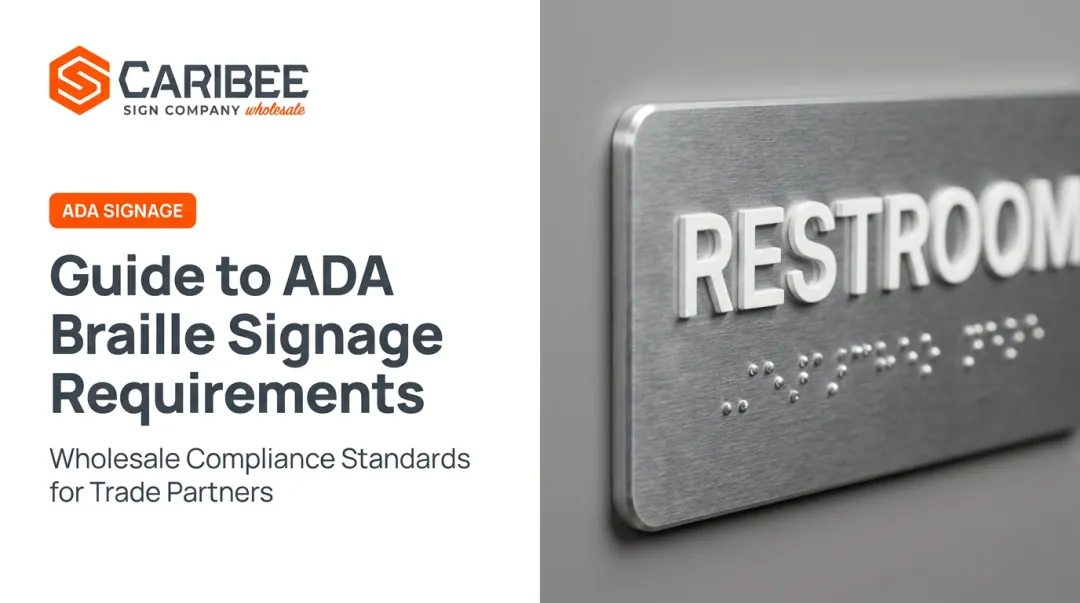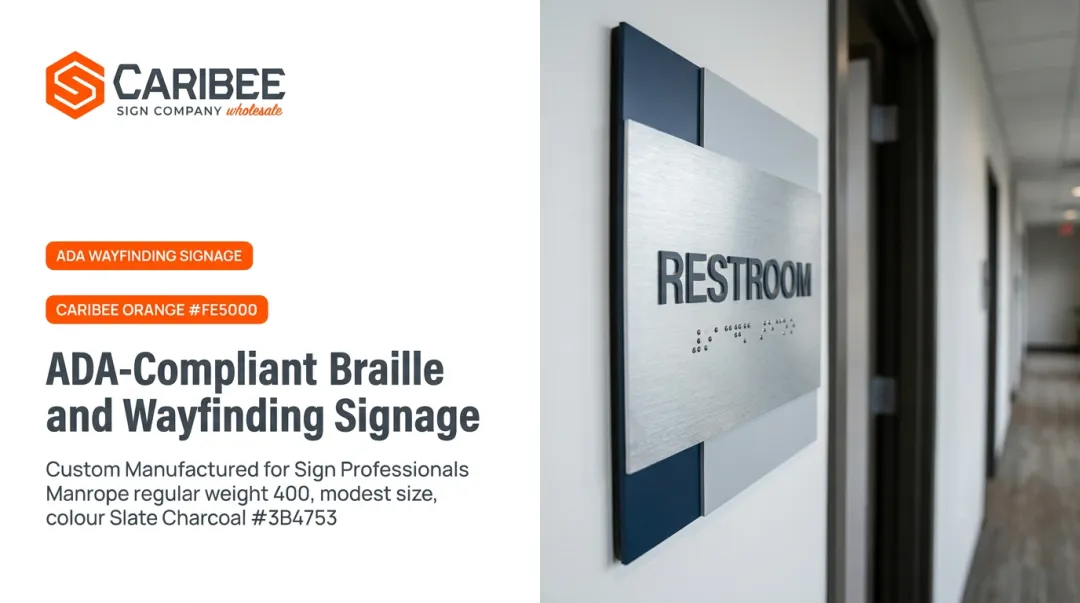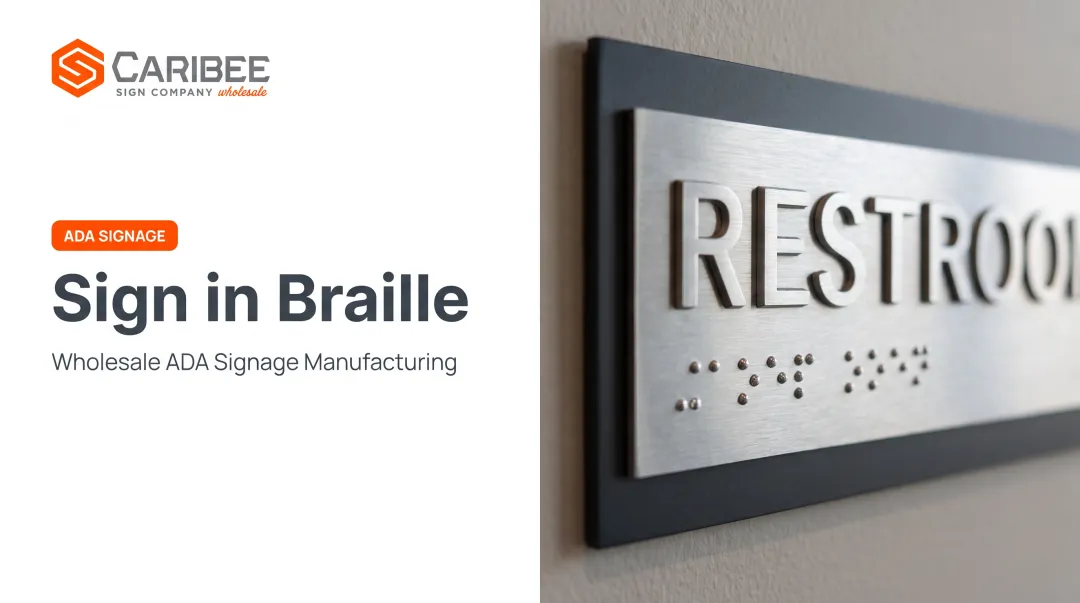

Many sign companies and facility managers still struggle to keep pace with current federal specifications for braille dimensions, tactile character sizing, and mounting placement. The rules are precise, and small errors get flagged during inspection.
This guide covers where braille signs are legally required, the exact specification requirements for 2023, mounting rules that trip up even experienced installers, and how to avoid the mistakes that lead to compliance failures.
Key Takeaways
- Post tactile braille signs at every permanent room, restroom, exit, and stairwell doorway
- Use Grade 2 domed braille below text, 48–60 inches high on the latch side
- DOJ Title III penalties hit $118,225 (first offense) and $236,451 (repeat)
- An experienced ADA signage manufacturer cuts compliance risk and reinstallation cost
Where Braille Signs Are Required in Government Buildings
Under the 2010 ADA Standards (Sections 703.1, 703.2, and 703.5), any sign identifying a permanent room or space in a state, county, or local government facility must include raised characters plus contracted Grade 2 Braille.
Mandatory locations include:
- Restrooms and locker rooms
- Exit routes and stairwell doors
- Areas of refuge
- Elevator hoistway entrances and control panels
- Office and room identification signs
- Cafeterias, conference rooms, mechanical rooms, and libraries
Permanent vs. Temporary/Changeable Signage
Not every sign needs braille. Temporary signage — anything posted for six weeks or less — and building directories are exempt from tactile requirements.
For rooms with rotating occupants, such as offices that change hands frequently, facilities managers should use insert-style signs. These pair a permanent, braille-inscribed room number with a changeable name insert, satisfying compliance without requiring a full sign swap every time staff changes.
Exceptions
Compliance exceptions are narrower than many assume:
- Detention facilities: Only signs outside public-use areas are exempt (Section 216.1, Exception 4). This is not a blanket exemption for prisons.
- Historic properties: National Register buildings must still comply "to the maximum extent feasible." A limited exception requires a State Historic Preservation Officer determination and covers routes and entrances, not room-ID signage broadly.
Even with those narrow carve-outs, most government rooms and spaces still need compliant tactile and Braille signs. According to the CDC's Fast Facts on Vision Loss, roughly 7 million people in the U.S. have vision impairment, including 1 million who are blind—the population these facilities are legally required to serve.
Braille & Tactile Character Specification Requirements
Federal specs under Table 703.3.1 leave little room for interpretation.
Braille dimensions:
- Dot base diameter: 0.059–0.063 inch
- Dot height: 0.025–0.037 inch
- Within-cell spacing: 0.090–0.100 inch
- Adjacent-cell spacing: 0.241–0.300 inch

Placement and grade rules are equally strict:
- Grade 2 (contracted) braille only
- Positioned directly below the corresponding text (below the full text block if multi-line)
- At least 3/8 inch separation from other tactile elements, raised borders, or decorative trim
Raised Character Rules
- Minimum 1/32 inch raised height above the background
- Uppercase, sans-serif only: no italics, script, or decorative fonts
- Character height: 5/8 inch to 2 inches (measured by the uppercase "I")
- Non-glare finish with strong light-on-dark or dark-on-light contrast
Federal standards don't set a specific numeric contrast (LRV) threshold, but the visual difference must be unmistakable.
One thing to flag for multi-state projects: California's Title 24 sets its own braille spacing table (Table 11B-703.3.1), with slightly different adjacent-cell spacing and line-spacing requirements than the federal minimums. If you're producing signage for California government buildings, check the state code separately. It doesn't default to federal numbers.
Mounting Height & Placement Rules for Government Facilities
Placement errors are one of the most common reasons signs fail inspection.
Standard mounting requirements:
- Baseline of tactile characters: 48–60 inches from the finished floor
- Centered within an 18 × 18-inch clear floor space
- Positioned outside the door's swing arc (45-degree clearance)

Door-Side Placement
Signs go on the latch side of the door. For double doors:
- One active leaf: mount on the inactive leaf
- Two active leaves: mount to the right of the right-hand door
If wall space isn't available at the latch side, use the nearest adjacent wall instead.
Door-mounted signs are allowed only when all three conditions are met:
- No closer-and-hold-open device combination that would block access
- Adequate approach clearance
- Placement on the push side of the door
Elevator-Specific Rules
Elevators follow separate ADA rules:
- A raised star must mark the main entry level on both door jambs
- Floor numbers appear in braille and tactile characters on both jambs, at least 2 inches high
- Control buttons need floor designations at least 3/4 inch in their smallest dimension, in ascending order
- Braille for each control button sits 3/16 inch from the corresponding raised character, directly below or adjacent to it
Enforcement & Penalties for Non-Compliance
The DOJ enforces ADA signage requirements under Title III, and the dollar figures have gone up since the original 2014 numbers many people still quote.
Current civil penalty maximums, per 28 CFR 85.5:
| Violation | Maximum Penalty |
|---|---|
| First violation | $118,225 |
| Subsequent violation | $236,451 |

Title II, which covers state and local government entities directly, doesn't carry the same statutory civil-penalty schedule. Noncompliant facilities still face:
- DOJ complaint investigations
- Compliance agreements
- Injunctive relief
- Civil litigation
Local building inspectors handle most routine enforcement and often grant a grace period for correction before escalating. Federal cases still happen.
The DOJ's 2019 settlement with the City of Hudson, New York is a clear example. The agreement cited a city facility for lacking a permanent room-identification sign with raised characters and braille on the latch-side wall, referencing Sections 216.2 and 703.1–703.5 directly. Even a single missing sign at a single doorway can trigger federal action.
Choosing a Reliable ADA Braille Sign Partner
Designing ADA signage in-house is risky. The specification tolerances are tight: fractions of an inch matter. A single dimension error means reprinting an entire order, or worse, failing inspection after installation.
Working with a manufacturer that specializes in ADA-compliant signage removes most of that risk. Caribee Sign, for example, focuses on signage that meets federal and state accessibility requirements: Grade 2 contracted braille, correct raised-character sizing, proper placement, and compliant contrast. That work supports sign companies and businesses handling government projects nationwide.
What to Look for in a Signage Partner
Before committing to a supplier for a government project, vet them against these criteria:
- Compliance documentation — Do they provide written ADA compliance guidelines and verification support, not just a promise?
- Material and production quality — In-house CNC routing, laser engraving, and precision fabrication produce more consistent tactile results than outsourced or mixed-vendor production.
- Turnaround time — Ask for real production timelines—Caribee typically quotes within one business day and produces most orders in 2–3 weeks, which matters on multi-building government rollouts.
- Ongoing support — Repeat government contracts need a partner who handles volume pricing, multi-site coordination, and consistent specs across every order, not just a one-off transaction.
Frequently Asked Questions
What are the guidelines for braille signage?
Braille must be Grade 2 (contracted), with domed dots positioned directly below the corresponding text. It requires at least 3/8 inch separation from other tactile characters and must meet ADA dot height and spacing specs.
What are the requirements for a braille exit sign in an ADA building?
Exit and exit-route signs need raised characters and braille at every egress decision point, including stairwells and areas of refuge. Pictograms are optional but raised text and braille are not.
Are all rooms in a government building required to have braille signs?
No. Only permanent room and space identification signs require braille. Temporary signage in use for six weeks or less, and building directories, are exempt.
How high should ADA braille signs be mounted?
Mount tactile characters with a baseline between 48 and 60 inches from the finished floor. Signs go on the latch side of the door, outside the door's swing arc.
What happens if a government facility fails to comply with ADA braille sign rules?
Under Title II, the DOJ can investigate, seek settlement agreements, and sue for injunctive relief and attorney's fees. Private parties can also file suit to force corrective action and recover related costs.
Can existing non-compliant signs be retrofitted instead of replaced?
Retrofitting rarely meets exact spacing, height, and dot-dimension requirements. Full replacement with ADA-compliant signage is usually the safer path.