
ADA compliance often gets discussed like a legal checkbox: install the right signs, avoid a fine, move on. But the actual value shows up in the exam room, the hallway, the restroom door — in a patient's ability to navigate a facility independently, safely, and with dignity.
This article covers why healthcare Braille signage matters in practice, what ADA compliance actually requires, and how facilities and sign companies can get it right the first time.
TL;DR
- ADA requires Braille signage on permanent rooms in healthcare facilities; non-compliance brings legal and reputational risk
- Braille signs improve safety, independence, and satisfaction for visually impaired patients
- ADA sets exact rules for character height, contrast, mounting height, and Braille placement
- An experienced ADA signage manufacturer lowers compliance risk and installation friction
What Are Healthcare Braille Signs?
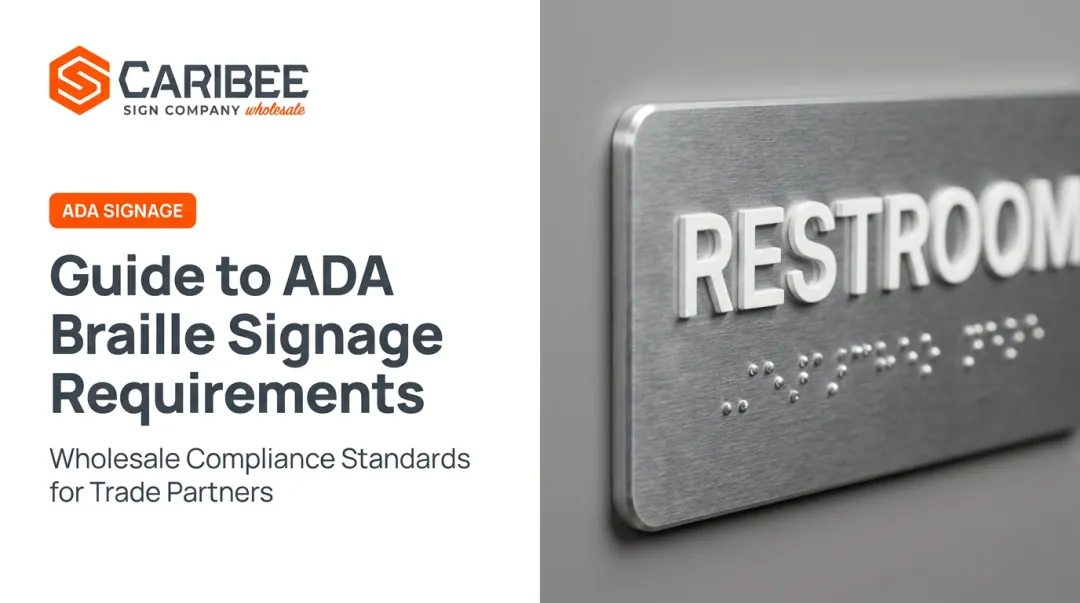
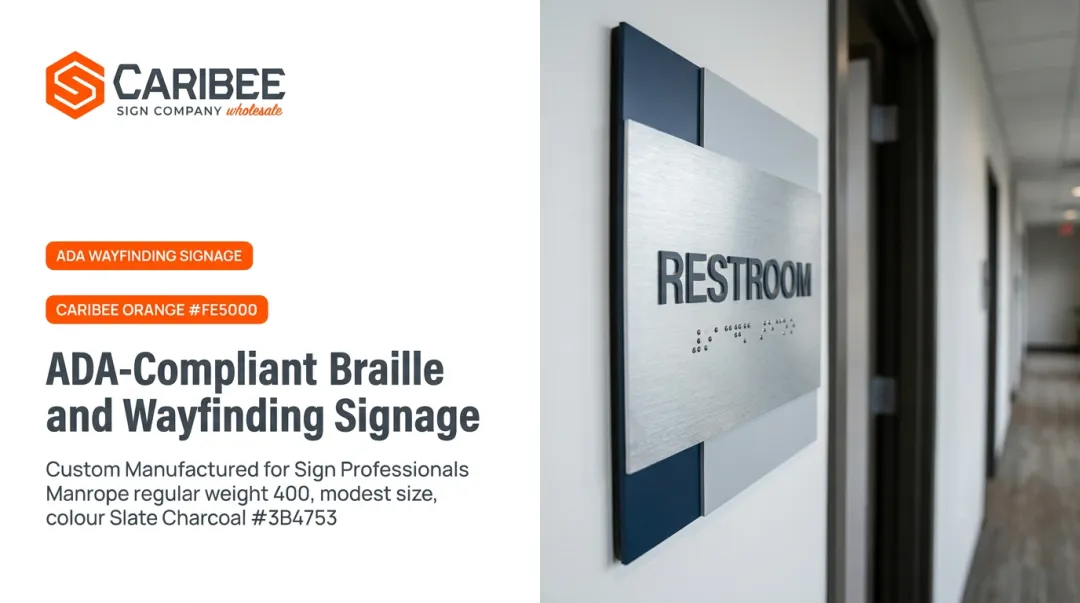
Braille signs combine raised tactile characters with Grade 2 Braille to identify rooms, exits, and facilities for people who are blind or visually impaired.
In healthcare settings, they typically appear on:
- Patient room numbers
- Restroom doors
- Exit stairways and passageways
- Department and suite signage
- Elevators and elevator landings
These signs support safe, independent navigation and legal compliance in hospitals, clinics, and other medical facilities.

Why ADA-Compliant Braille Signage Matters in Healthcare
The advantages below tie to measurable outcomes: legal risk, patient safety, and reputation, not abstract inclusivity claims.
Patient Safety and Independent Navigation
Braille signs let visually impaired patients find exam rooms, restrooms, and exits without depending on staff or companions. In a hospital corridor full of similar doors, that independence matters.
Clear tactile wayfinding also reduces anxiety and disorientation, both already elevated in high-stress medical settings.
The CDC estimates that roughly 32.17 million Americans had some degree of presenting visual-acuity loss in 2024 (9.46% prevalence across all ages) (CDC VEHSS data). More than 700,000 are classified as blind. Among adults 71 and older, one study found 27.8% had measurable visual impairment.
KPIs impacted:
- Patient satisfaction scores
- Incident and complaint rates
- Patient wait and navigation time
This matters most in emergency departments, multi-story hospitals, and any facility with a complex or maze-like layout.

Legal Compliance and Risk Mitigation
ADA Title III legally requires Braille and raised characters on permanent room identification signs: room numbers, restroom labels, and tactile exit markings at stairways and passageways.
Non-compliant signage exposes hospitals and clinics to:
- DOJ complaints and Title III lawsuits
- Costly retrofits after an inspection flags a violation
- Delayed facility openings while compliance issues get resolved
The DOJ's Barrier-Free Health Care Initiative has pursued numerous settlements with healthcare providers over accessibility gaps. Separate enforcement actions (including one involving a deaf-blind patient and a Washington state healthcare system) show that disability-access obligations are enforced seriously, even when the issue is not physical signage.
The lesson holds either way: accessibility compliance is not optional.
KPIs impacted:
- Legal exposure
- Retrofit costs
- Facility audit pass rates
This matters most during renovations, new construction, or after a facility ownership change triggers a fresh compliance review.
Reputation, Trust, and Patient Experience
Visible accessibility commitment signals inclusivity and builds trust with patients and their families. Word-of-mouth and online reviews increasingly reference accessibility experiences, not just clinical outcomes.
A 2025 analysis of over 22,500 US adults found that disabled patients rated their healthcare experience lower on average (7.98 out of 10) than patients without disabilities (8.38 out of 10), with disabled respondents reporting less timely care and weaker provider interactions (PMC study).
Wayfinding and signage were not isolated variables in that study, but the broader pattern is clear: accessible experiences drive perception.
KPIs impacted:
- Patient retention
- Online review sentiment
- Referral rates
Facilities serving elderly populations and specialty clinics, where visual impairment rates run higher, feel this gap first.
ADA Braille Sign Requirements Healthcare Facilities Must Follow
ADA Title III and the 2010 ADA Standards set exact specifications for Braille and tactile signs. Healthcare facilities that get these details right the first time avoid costly retrofits later.
Key requirements:
- Raised character height: 5/8 inch to 2 inches (uppercase "I" measurement), with characters projecting a minimum of 1/32 inch
- Braille placement: Grade 2 (contracted) Braille goes directly below the corresponding text, or below the full text block if multi-lined
- Braille spacing: At least 3/8 inch from other tactile elements or raised borders
- Contrast and finish: Non-glare finish with strong contrast — light characters on dark background, or dark on light
- Mounting height: Tactile character baselines between 48 and 60 inches above the finished floor
- Door placement: Mounted beside the door on the latch side; on double doors, mount on the latch side of the active leaf

One nuance that trips facilities up: directional and informational signs, such as overhead signs pointing toward "Radiology" or "Cafeteria," generally only require visual compliance. Braille is required specifically for signs identifying permanent rooms and spaces, such as room numbers, restrooms, and offices.
What Happens When Healthcare Facilities Get Braille Signage Wrong
Getting Braille signage wrong rarely shows up as one big failure. It shows up as accumulated friction:
- Inconsistent signage across departments, confusing both patients and staff
- Rising complaint rates and exposure to ADA lawsuits or DOJ scrutiny
- Costly last-minute retrofits triggered by inspections or complaints
- Damaged standing with disability advocacy groups and patient communities
- Delayed facility openings or renovation sign-offs while compliance gets sorted out
The U.S. Access Board is direct about this: designing accessibility correctly from the start avoids the more expensive retrofit path later. A retrofit usually means removal, re-inspection, and reinstallation—often under time pressure—not just swapping the sign.
Choosing the Right Braille Signage Partner for Healthcare Projects
ADA signage works best when sign companies choose manufacturers who understand precise ADA specifications, not generic vendors treating Braille as an afterthought.
A dependable manufacturing partner should:
- Handle Braille translation in-house so sign companies don't have to source accurate Grade 2 Braille copy themselves
- Produce tactile characters to ADA specification with correct height, projection, spacing, and contrast every time
- Support consistent quality across large rollouts, including multi-building hospital campuses and multi-phase renovations
- Respond quickly to quote requests, because healthcare construction timelines rarely have slack
Caribee Sign is a wholesale ADA signage manufacturer for sign companies running healthcare projects that need dependable, compliant products without friction in the order process.
In-house production uses CNC routing, laser engraving, and precision fabrication for raised tactile characters, tactile pictograms, and Grade 2 Contracted Braille on materials such as stainless steel, acrylic, and composite substrates. Mark a Braille placeholder on the artwork; Caribee handles translation and production.

Wholesale quote requests typically receive a response within one business day, which matters when a renovation deadline or inspection date is already on the calendar.
Conclusion
ADA-compliant Braille signage in healthcare protects patient safety, dignity, and independence. Patients should be able to navigate a facility without depending on someone else.
The requirements are precise: raised character height, Grade 2 Braille placement, contrast, and mounting height between 48 and 60 inches. Getting any of these wrong carries real legal and reputational cost, and retrofitting after the fact almost always costs more than getting it right the first time.
For healthcare facilities and the sign companies serving them, treating ADA signage as an ongoing practice, supported by a dependable manufacturing partner, beats treating it as a one-time purchase.
Frequently Asked Questions
What is the ADA requirement for Braille signs in hospitals?
ADA Title III requires raised characters with Grade 2 Braille placed below the corresponding text on signs identifying permanent rooms. Signs also need non-glare finishes and high contrast between characters and background.
Do all hospital signs need Braille?
No. Only signs identifying permanent rooms or spaces — room numbers, restrooms, offices — require Braille. Overhead directional and informational signs typically only need to meet visual requirements.
What happens if a hospital doesn't have ADA-compliant Braille signage?
Non-compliant facilities risk DOJ complaints, ADA Title III lawsuits, and costly retrofits during inspections or after patient complaints. It can also delay facility openings or renovation approvals.
How high should Braille signs be mounted in medical facilities?
Tactile character baselines must sit between 48 and 60 inches above the finished floor, mounted on the latch side of the door for single-door entries.
Can existing hospital signage be retrofitted to be Braille-compliant?
Yes, retrofitting is possible, but it's typically more expensive than planning compliant signage during new construction or renovation. Removal, re-inspection, and reinstallation all add cost and time.
How do sign companies ensure ADA compliance when producing Braille signs for healthcare clients?
They rely on precise tactile character specifications, accurate Grade 2 Braille translation, and manufacturing partners like Caribee Sign that produce compliant signs in-house to those specifications.