
Facility managers and sign companies often struggle to keep pace with the technical specs: character height, braille placement, mounting ranges, and state-specific overlays on top of federal rules. Get it wrong and you're not just risking an awkward inspection. You're risking DOJ complaints, lawsuits, and delayed certifications.
This guide breaks down where ADA signs are legally required inside civic buildings, what the design and content rules actually say, how to handle installation, and what to look for in a signage supplier who won't leave you exposed.
Key Takeaways
- Civic buildings have virtually no size-based exemptions from ADA signage law
- Braille, raised characters, contrast, and mounting height must match exact ADA specs
- Non-compliance risks DOJ settlements, lawsuits, and stalled inspections
- Working with an experienced ADA signage supplier cuts compliance risk and rework
What Are ADA Signs and Why Civic Buildings Face Stricter Compliance
ADA signage falls under Section 216 and Section 703 of the 2010 ADA Standards for Accessible Design. These signs serve three purposes:
- Identification — permanent rooms and spaces (offices, restrooms, records departments)
- Direction and information — wayfinding, evacuation routes, department directories
- Accessible feature notification — marking accessible entrances, parking, and routes
ADA signs aren't limited to tactile room plaques. The category also includes purely visual directional and informational signage, which follows a different set of rules than tactile identification signs (more on that below).
Title II of the ADA covers every state and local government activity — courts, DMVs, libraries, schools, voting, and emergency services — regardless of the facility's size. That's a different standard than some private businesses face under Title III, where certain exemptions can apply.
Civic facilities are also a recurring enforcement target. The Department of Justice's Project Civic Access has produced settlement agreements with cities and counties across the country, including Denver, Killeen, Kansas City, and New Hartford Township. Those agreements specifically address signage deficiencies in government buildings.
When a citizen files a complaint about a courthouse or DMV, DOJ has a well-worn process for investigating it.
Where ADA Signs Are Required Inside Civic Buildings
Public Entrances, Security, and Lobby Areas
If not every entrance to a civic building is accessible, the accessible ones must carry the International Symbol of Accessibility (ISA). Directional signs at inaccessible entrances must point visitors to the nearest accessible entrance. Security checkpoints and visitor registration counters, when they are permanent fixtures, typically need compliant identification signage as well.
Courtrooms, Council Chambers, and Legislative Spaces
Federal standards don't create an automatic tactile-sign requirement just because a room is a courtroom or council chamber. What triggers the requirement is permanence: courtroom identification signs, jury assembly area signage, and public hearing room identification all fall under the same permanent-room rule as any office. Assembly areas with assistive-listening systems also need signage noting that availability.
Service Counters, Restrooms, and Elevators
Permanent department signage — records offices, permit counters, benefits offices — must be tactile and compliant no matter how small the department is. There's no square-footage exemption here. Restroom signage is one of the most common failure points DOJ finds during civic access reviews. Compliant restroom signs typically include:
- Raised characters and braille for restroom identification
- Men's / Women's designations paired with the ISA where applicable
- Unisex or family restroom identification
- Wheelchair accessibility symbols where the room is accessible Elevators carry their own detailed requirements:
- Floor designations in raised characters and braille on both hoistway jambs
- A tactile star marking the main entry level
- Control buttons that are raised or flush, at least 3/4 inch
- Buttons arranged in ascending order, with emergency controls grouped near the bottom

Design and Content Requirements for ADA-Compliant Civic Signage
Raised Characters and the All-Caps Question
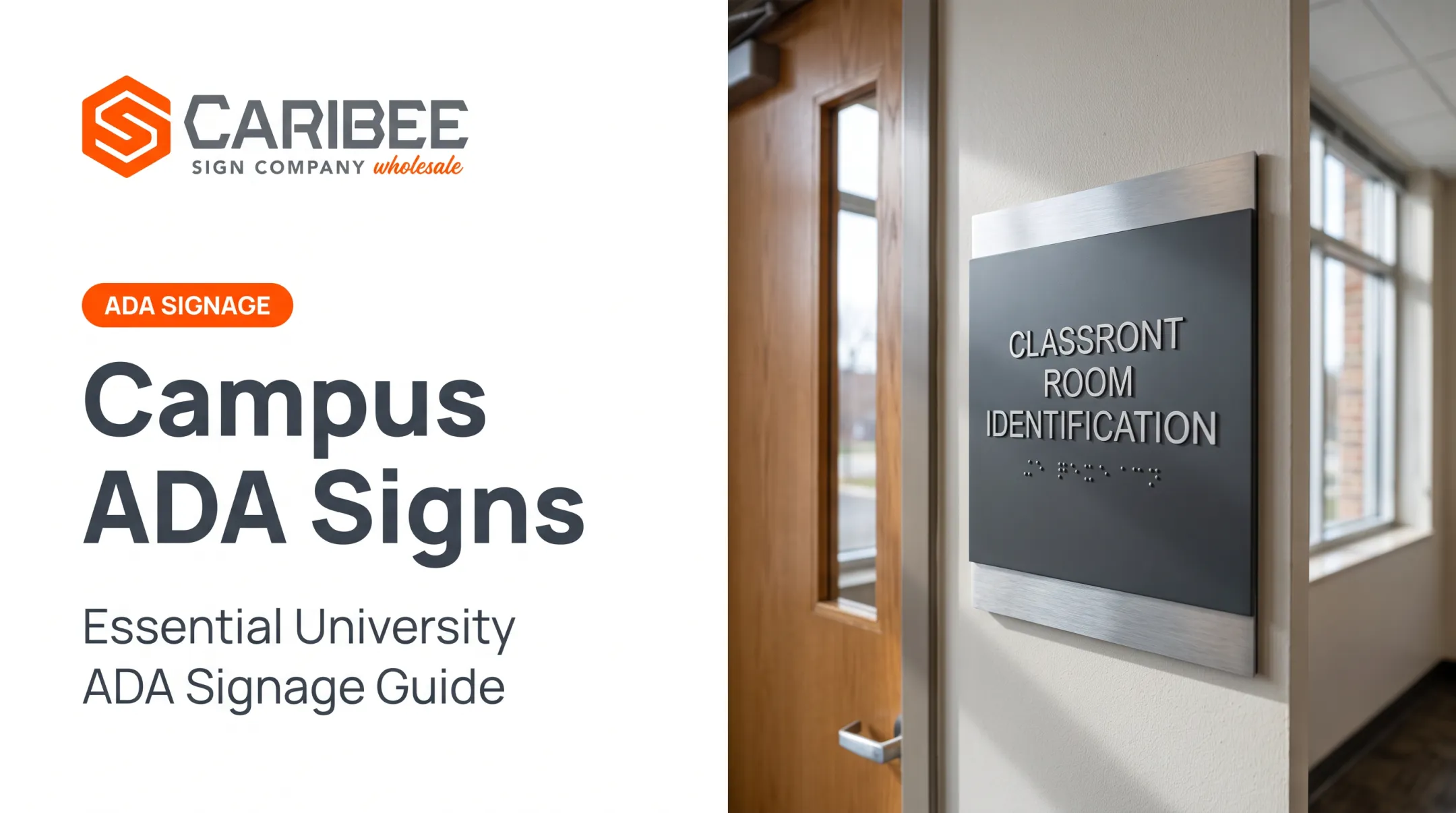
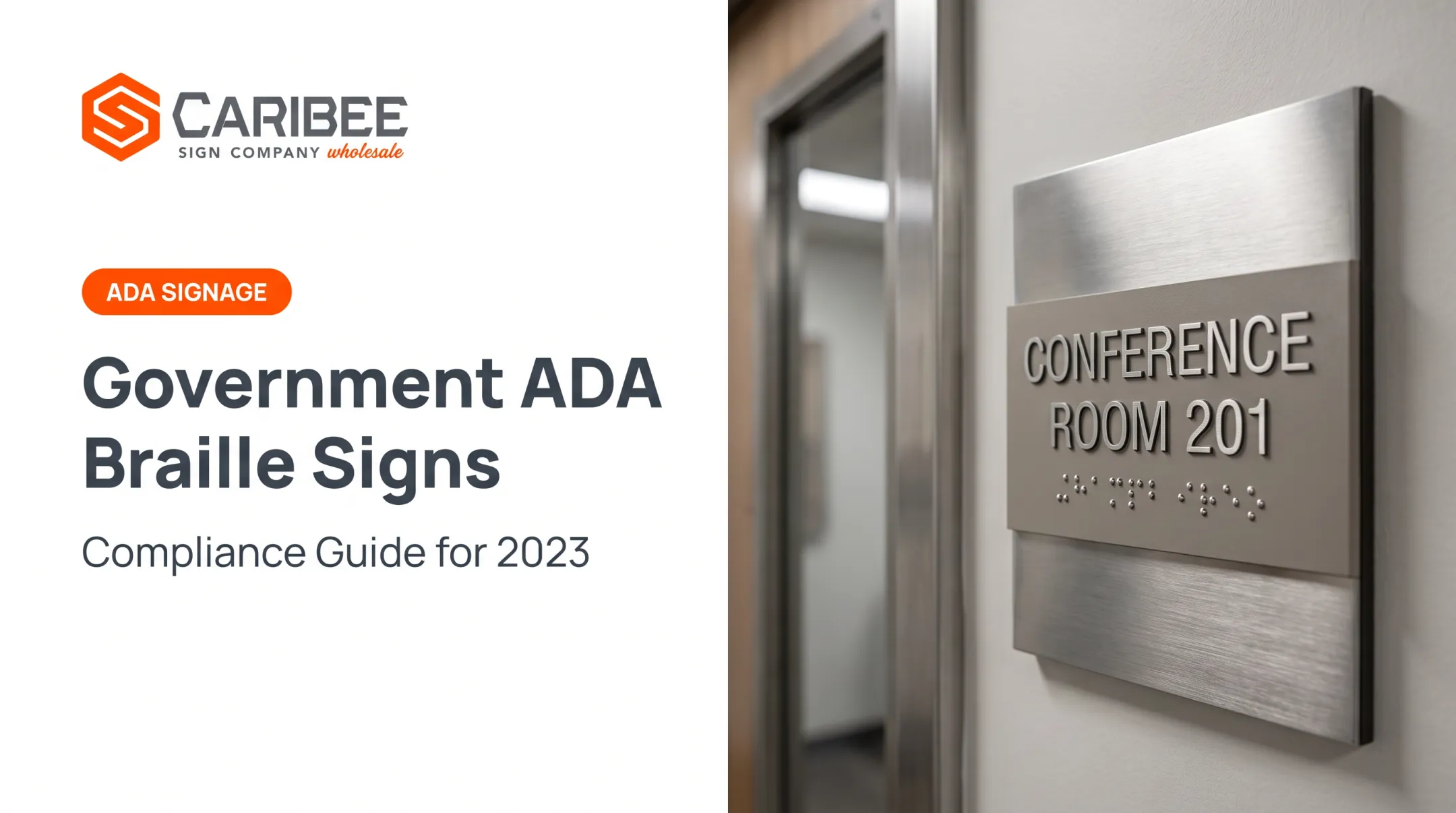
Tactile characters must be uppercase, sans serif, non-italic, and non-decorative. Key specs:
- Character height: 5/8 inch to 2 inches
- Stroke thickness: no more than 15% of character height
So does an ADA sign need to be all caps? For tactile characters, yes. Visual-only directional and informational signs may use upper or lowercase; they aren't held to the same tactile-character rule.
Braille Placement
Braille must be Grade 2 (contracted), formed with domed or rounded dots, and positioned below the corresponding text (below all lines if the text wraps). It needs at least 3/8 inch of separation from other tactile elements, with a narrower exception for elevator controls.
Contrast and Finish
Signs need a non-glare finish with strong contrast between characters and background, either light-on-dark or dark-on-light. The federal standard doesn't set a numeric contrast ratio; it simply requires visually distinguishable contrast and a non-glare surface.

Pictograms and Multilingual Complexity
Pictogram fields must be at least 6 inches high, with text descriptors placed directly below, never inside the pictogram itself. The International Symbol of Accessibility (ISA) is required at accessible entrances, restrooms, and parking.
Civic buildings often serve populations with limited English proficiency, which often means multilingual or symbol-heavy wayfinding beyond a typical commercial job. That's a design layer smaller sign shops sometimes overlook until a project is already underway.
Installation and Mounting Best Practices for Government Facilities
Mounting rules for ADA signs in government facilities are fixed requirements:
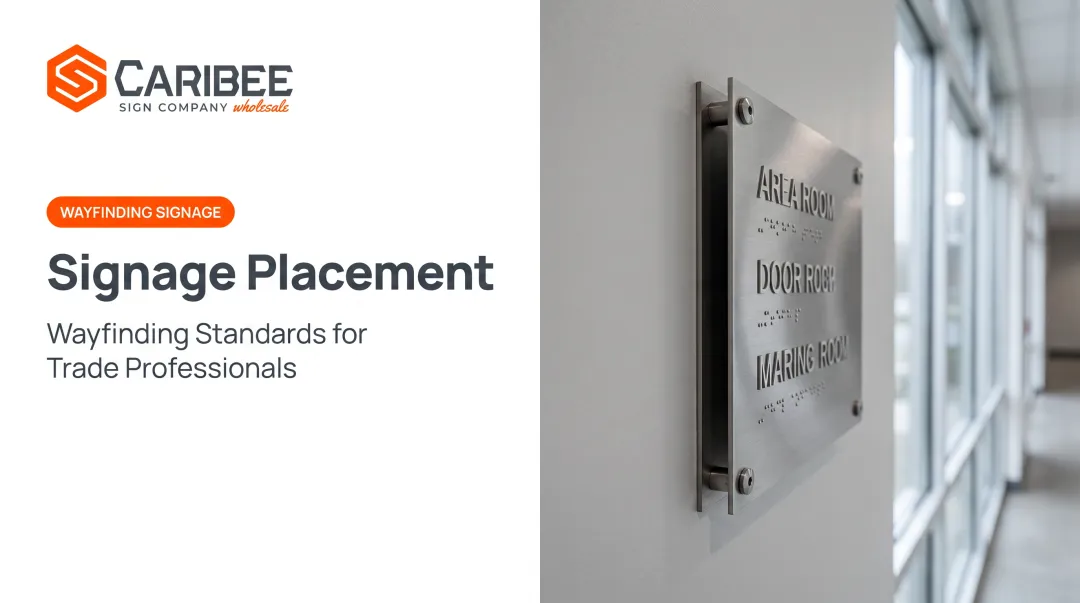
- Tactile character baseline height: 48 inches minimum to 60 inches maximum above the finish floor (lowest to highest character baseline)
- Clear floor space: at least 18 by 18 inches, centered on the sign and clear of the door swing
- Door placement: mount signs on the latch side of the door
- No wall space exception: if latch-side wall space is unavailable, use the nearest adjacent wall

For large civic projects with dozens or hundreds of rooms, complete a facility-wide sign inventory before ordering. Map every permanent room, restroom, elevator, and entrance against the applicable code section.
That prep work prevents the scramble when an inspector flags a missed sign mid-project.
What Happens When Civic Buildings Fail to Comply
DOJ Title II enforcement does not follow Title III's civil penalty structure. There is no standard fine schedule. Instead, DOJ can pursue monetary relief for affected individuals on a case-by-case basis.
In Lancaster County, Pennsylvania, that meant a $1,000 payment to a complainant, plus required signage and notice fixes.
Beyond financial exposure, non-compliance carries other costs:
- Lawsuits and DOJ settlement agreements requiring facility-wide remediation
- Delayed permits, inspections, or occupancy certifications
- Reputational harm to a public entity expected to serve all residents
A compliance audit before construction wraps up costs far less than a retrofit ordered after a citation. Once a courthouse or city hall is fully built out, replacing dozens of non-compliant signs is far more disruptive than getting the specs right the first time.
Choosing a Reliable ADA Signage Partner for Civic Projects
Civic projects rarely move in one clean phase. Multiple departments, staggered inspections, and shifting timelines are the norm — which means a signage partner needs to be responsive when specs change or new rooms get added mid-project.
Caribee Sign is a wholesale ADA signage manufacturer for sign companies handling this kind of complexity. Products meet ADA compliance requirements, with:
- Grade 2 contracted braille produced in-house
- Raised tactile characters, high-contrast visuals, and ISA pictograms
- Custom sizing, materials, and finishes for room ID, restroom, and wayfinding signage
- Quote responses typically within one business day

Before placing a large civic order with any supplier, confirm two things: the signage is manufactured to federal SAD specs, and state or local code overlays have been reviewed by the architect or facility ADA coordinator. Federal rules are the floor, not the ceiling. Some states go further.
Frequently Asked Questions
What is an ADA sign?
An ADA sign follows Section 216 of the 2010 ADA Standards for Accessible Design. It identifies a permanent room or space, provides direction or information, or marks an accessible feature such as an entrance or restroom.
Do ADA signs need to be all caps?
Tactile, raised-character signs must be uppercase, sans serif, and non-decorative. Visual-only directional and informational signs aren't held to this rule and may use mixed case.
What are some ADA-compliant restroom signs?
Common compliant restroom signs include Restroom, Men's, Women's, Unisex, and Family designations, each with raised characters and Grade 2 Braille. The ISA pictogram is required where the restroom is accessible.
Are civic and government buildings exempt from any ADA sign requirements?
Exemptions are minimal and largely limited to specific historic-building circumstances. The vast majority of civic facilities — courthouses, city halls, DMVs, libraries — must fully comply with federal signage standards.
How high should ADA signs be mounted in a courthouse or city hall?
Tactile signs must be mounted between 48 and 60 inches from the floor, measured from the baseline of the lowest and highest tactile characters. They should also be placed on the latch side of the door where possible.