
This matters more than ever. NCES reports 7.5 million students ages 3-21 received services under IDEA in 2022-23, 15% of total public-school enrollment. That's a lot of hallways, classrooms, and restrooms that need to work for everyone.
This guide breaks down what actually makes a classroom sign compliant, how Braille and mounting rules work in practice, and how sign companies can source these signs through a wholesale partner that gets the details right the first time.
Key Takeaways
- ADA signage is legally required in schools for classrooms, restrooms, and common areas, public and private alike
- Braille and raised tactile text must meet exact height, spacing, and dot geometry specs; there's no room for "close enough"
- High-volume school contracts demand a wholesale partner who manufactures to code consistently
What Are ADA Signs and Why Schools Need Them
ADA signage refers to signs that meet the accessibility standards set out in the Americans with Disabilities Act, specifically the 2010 ADA Standards for Accessible Design.
Public school systems must comply across all services and activities, including anything open to parents or visitors. Private schools aren't exempt either: they're covered as places of public accommodation under Title III.
For sign companies, schools are demanding clients. They're high-volume (hundreds of rooms across multiple buildings) and high-scrutiny (parents, advocacy groups, and the Department of Justice all pay attention).
What happens when schools get it wrong?
- Federal settlement agreements requiring full sign replacement
- Corrective-action deadlines with compliance audits
- Legal costs and reputational damage that outlasts the fix itself
DOJ enforcement records make this concrete. At Lakewood Elementary, a multi-purpose-room sign lacked raised letters and Braille entirely, while two other room signs were mounted at the wrong height. Regulators required a full sign replacement across the building, not a simple warning.
Sign companies supplying schools carry that risk on every order. Each unit shipped has to meet code, because one missed spec can trigger a district-wide audit.
The Anatomy of a Compliant ADA Classroom Sign
Material and Visual Requirements
Classroom signs typically use acrylic or translucent/frosted materials, chosen for durability and a clean, non-glare finish. Matte and frosted surfaces are the go-to choices here. Glossy or polished finishes work for other applications but undermine ADA non-glare readability requirements.
Text and background need strong contrast: light-on-dark or dark-on-light, never a mid-tone blend that blurs together under hallway lighting. Font matters too:
- Sans serif only — no exceptions
- Uppercase for raised tactile copy
- No italic, oblique, script, or "highly decorative" styles
- Character height between 5/8" and 2"
Common two-tone combinations for classroom ID signs include teal/turquoise, black/tan, and red/white, though custom PMS or Sherwin-Williams color matching is standard practice for districts with branding requirements.
Tactile and Symbol Elements
Raised characters must sit at least 1/32 inch above the sign's background. It is a small measurement, but inspectors check it by touch, not just sight. Corresponding Grade 2 Braille belongs below the raised text, domed and properly spaced. Pictograms (like a wheelchair symbol) need a minimum 6-inch square field, with text descriptors placed directly below rather than crammed inside the field itself.
Edges and corners matter too. Signs read by touch in busy hallways shouldn't have sharp or abrasive edges, a detail easy to overlook in production but critical for both compliance and student safety.

Braille Signage Requirements for Schools
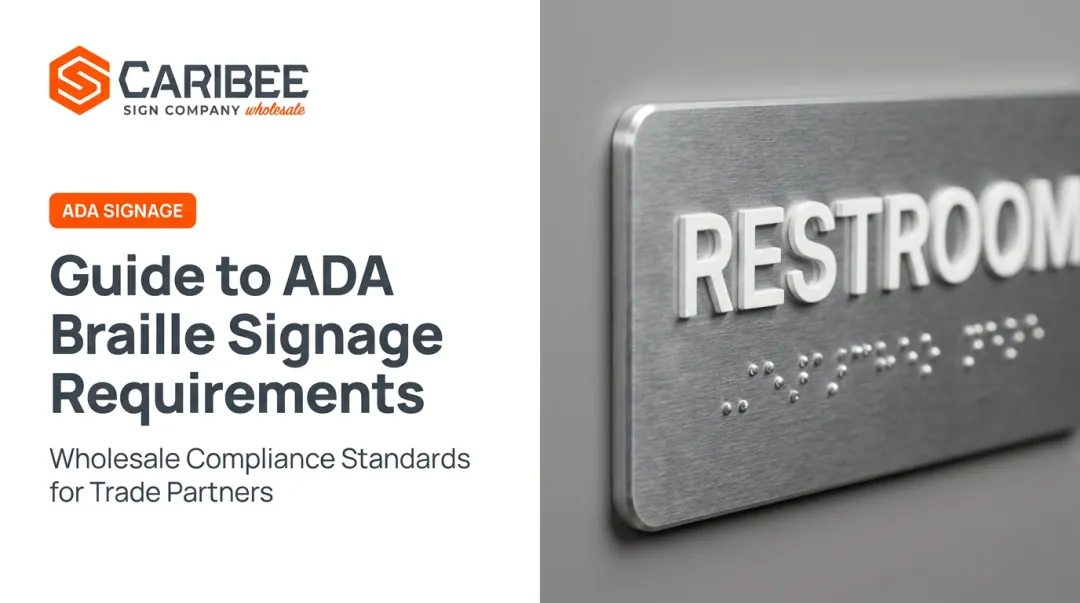
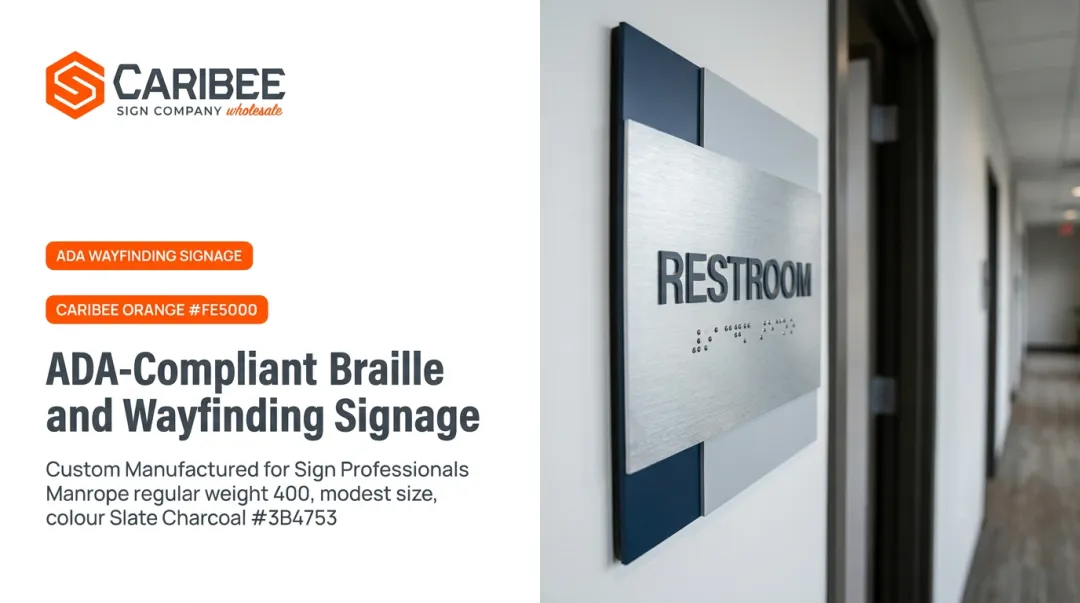
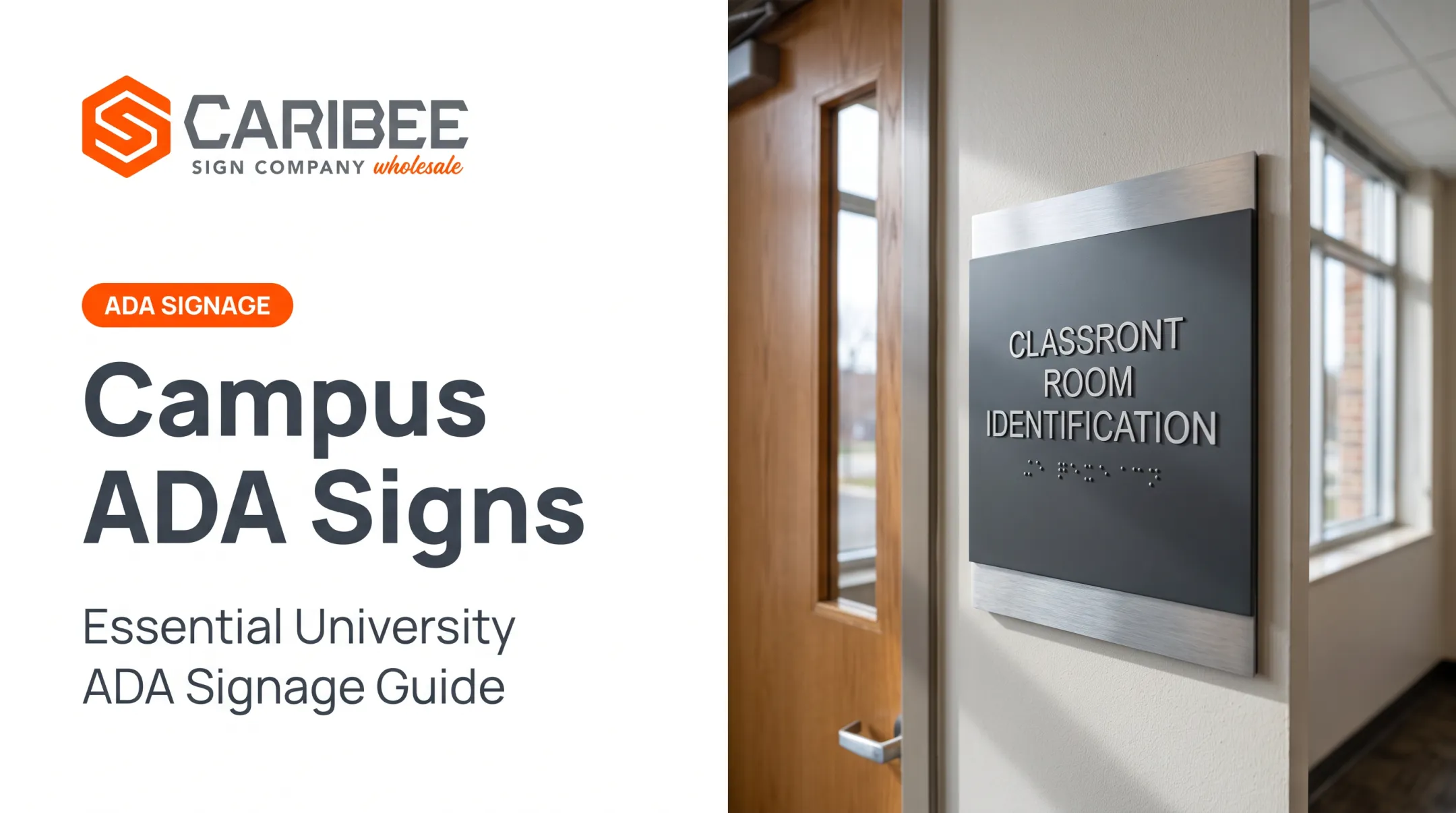
Every classroom sign needs Grade 2 (contracted) Braille, positioned 3/8" to 1/2" below the last line of raised text. Inspectors treat this as a hard requirement. Missing or incorrect Braille ranks among the most common DOJ enforcement failures.
Mounting height is just as strict:
- Lowest tactile character baseline: at least 48" from the floor
- Highest tactile character baseline: no more than 60" from the floor
- Placement: latch side of the door, never the hinge side
Why the precision? Braille dot spacing and dome height directly affect readability for someone reading by touch. Get the spacing wrong, and the sign might look compliant while functioning as decoration.
Common installation mistakes to avoid:
- Mounting the sign in the door's swing path (it needs an 18" x 18" clear floor space outside the swing arc)
- Placing signs on the hinge side instead of the latch side
- Using the sign's centerline instead of the baseline to measure height
- Skipping Braille on permanent room signs because "it's just a classroom"

These aren't hypothetical. DOJ settlement records from Kanawha County schools cite exactly these errors: missing Braille, wrong mounting height, and rooms that didn't match their signage at all.
Where ADA Signs Are Required Throughout a School Campus
Permanent room identification signs are required well beyond the classroom door. Districts need compliant signage at:
- Classrooms and administrative offices
- Restrooms and locker rooms
- Libraries and media centers
- Gyms and cafeterias
- Conference and mechanical rooms
Beyond room ID, campuses also need directional and informational signage so students, staff, and visitors can navigate multi-building layouts. These signs must meet visual rules for contrast and character height, but they are not required to be tactile—a distinction that trips up many first-time school projects.
Accessibility features carry their own sign rules. Mark each of the following with the International Symbol of Accessibility:
- Accessible entrances
- Ramps
- Elevators
- Designated accessible parking spaces
Placement matters as much as content. One DOJ case required a "Van-Accessible" sign positioned so parked vehicles could not block it.

Partnering with a Wholesale ADA Signage Provider for School Projects
Fulfilling a school signage contract isn't like a standard office job. Districts often need hundreds of signs across multiple buildings, on a tight academic-calendar deadline, with zero tolerance for compliance errors.
That's where a dependable wholesale manufacturing partner earns its place in a sign company's workflow. Caribee Sign has spent over 60 years producing custom ADA-compliant signage, including classroom identification and Grade 2 Braille signs, for sign companies handling exactly this kind of contract.
What that partnership looks like in practice:
- In-house Braille translation, so partners don't need to source or verify Braille copy themselves
- CNC routing and precision laser engraving for consistent raised-character depth and Braille dot geometry
- ADA compliance guidelines shared as a reference through design and production
- Quote responses typically within one business day

Hugh Welch of Hugh-Carolina Sign Co. calls Caribee his company's "go-to" provider for ADA signage, citing responsiveness and consistent quality that meets code.
For sign companies bidding on school and university contracts, having a manufacturing partner who handles the compliance details means they can quote confidently, without absorbing the risk of a rejected sign order mid-project.
Frequently Asked Questions
What is the recommended height for an ADA sign?
Tactile characters must have their lowest baseline at least 48 inches from the floor, with the highest baseline no more than 60 inches. Measure from the baseline, not the sign's center or edge.
What does ADA stand for in signs?
ADA stands for the Americans with Disabilities Act. This federal civil rights law requires accessible signage in schools, workplaces, and public spaces so people with disabilities have equal access.
What classroom number signs work best?
Room-ID signs with raised numerals, Grade 2 Braille, and high-contrast two-tone finishes work well for classrooms. Many districts also request custom color combinations to match building branding.
Do private schools need ADA signage too?
Yes. Private elementary and secondary schools are covered under Title III as places of public accommodation, meaning they must meet the same signage accessibility standards as public schools.
How often should school ADA signage be inspected or updated?
Schools should audit signage periodically, and always after room reassignments, renovations, or new construction. A room number change without an updated sign is a common compliance gap inspectors flag.